Arquivo por Autor

‘El juicio de Paris’, de Rubens

Tal día como hoy fallecía en Amberes en 1640 Pieter Pauwel Rubens [28 Junio 1577 – 30 Mayo 1640], pintor barroco de la escuela flamenca.

La historia del Juicio de Paris se remonta a las bodas de Tetis y Peleo, narrada en las Fabulas de Higinio. En el banquete, Eris, diosa de la Discordia, lanzó una manzana retando a la más hermosa de las diosas a que la recogiera. Ante la disputa entre Venus, Juno y Minerva, Zeus decidió darle la manzana a Mercurio y que Paris actuase como juez.
El juicio aparece descrito en las Heroidas de Ovidio (XVI 65-88):
“(…)el heraldo alado me dijo: “tú eres el arbitro de la belleza; termina con las aspiraciones de las diosas; pronuncia cual de ellas merece derrotar a las otras dos a causa de su belleza” (…) la consorte Juno me ofreció tronos, su hija, poder en la guerra(…) Dulcemente Venus sonrió: “Paris, no dejes que esos regalos te conmuevan, ambos están llenos de miedo!” me dijo “mi regalo será el amor y la belleza de la hija de Leda, más hermosa que su madre, que vendrá a tus brazos”.
Finalmente Paris optó por esta última consiguiendo así la mano de Helena, desencadenando la guerra de Troya.
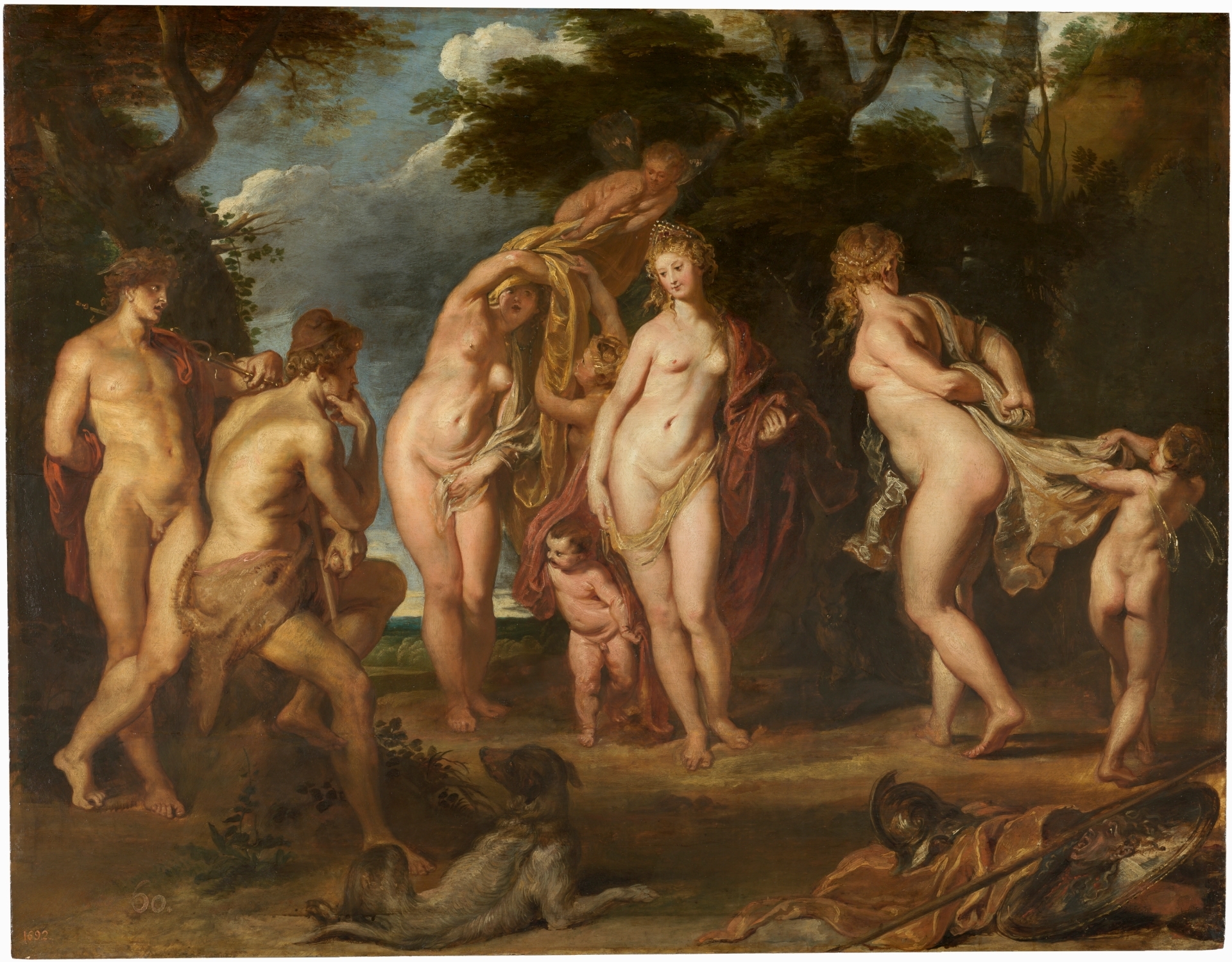
El tema del Juicio de Paris fue utilizado por Rubens en multitud de ocasiones, permitiendo al autor deleitarse en el ideal de belleza femenino, y también considerar las consecuencias del amor. Al igual que sucede con otras de las versiones del artista sobre este tema, la atención recae en el grupo de diosas que se encuentran en el centro de la composición, rodeadas de cupidos que tratan de quitarles la ropa. Venus, en medio de las tres y coronada, se muestra más tranquila que las otras, que parecen luchar para desvestirse. Los hombres, en la parte izquierda, parecen casi ajenos a la composición, como si la contemplaran en vez de participar en ella. A pesar de ser una pintura temprana se relaciona con algunas de las características de sus obras más tardías, como es la diferencia en el tratamiento lumínico de los personajes, destacando el brillo y la frialdad de los cuerpos femeninos frente a los masculinos, que reciben una luz menor y más cálida. Además los cuerpos desnudos, construidos mediante líneas sinuosas y ondulantes, y la mirada de Venus evocan la sensualidad y el amor de sus últimas obras. La principal diferencia es la técnica, ejecutada en este caso con una pincelada menos suelta y con mayor importancia de la línea.

Via Museo del Prado.

Narciso Yepes plays Isaac Albéniz

Narciso Yepes recria o tema Asturias na passagem do 160º aniversário do nascimento do virtuoso compositor espanhol Isaac Albéniz [29 Maio 1860 – 18 Maio 1909]

Jimmy Cobb, the last ‘Kind of Blue’

Jimmy Cobb [1929-2020] era último sobrevivente do notável sexteto de músicos – Cannonball Adderley ( saxofone alto), Paul Chambers (baixo), Jimmy Cobb (bateria), John Coltrane (saxofone tenor ), Bill Evans (piano) que o trompetista Miles Davis reuniu em Agosto de 1959 para gravar Kind of Blue.
Morreu ontem, dia 24 de Maio de 2020, aos 91 anos.

‘Journey to the Centre of the Earth’, by Rick Wakeman

[Narrator]:
The story begins on the 24th of May 1863 in Hamburg, when Professor Lidenbrock and his nephew Axel discover an old parchment in a 12th century book called ‘Heims Kringla’. A chronicle of the Norwegian princes who ruled over Iceland this parchment, when decoded into Latin and translated by Axel proved to be written by an alchemist of the 16th century and read as follows:
“Descend into the crater of Sneffels Yokul, over which the shadow of Scataris falls before the calends of July bold traveller, and you will reach the centre of the Earth I have done this. – Árni Signússon”
Sneffels is a five-thousand foot-high mountain in Iceland an extinct volcano, its last eruption having been in 1229…
And so the journey from Hamburg to Iceland begins.

‘All Blues’, by Oscar Peterson & Freddie Hubbard

Do álbum Face To Face, gravado em 24 Maio 1982, o tema de abertura All Blues, escrito em 1959 por Miles Davis para Kind of Blue.

Oscar Peterson, piano | Freddie Hubbard, trompete | Joe Pass, guitarra
Niels-Henning Ørsted Pedersen, contrabaixo | Martin Drew, bateria

‘Africa’, de John Coltrane

Africa/Brass, o primeiro trabalho que John Coltrane gravou para a Impulse após dois anos com a Atlantic Records, contou com um vasto conjunto de músicos e instrumentos, de onde sairia o primeiro Quarteto: Elvin Jones, Jimmy Garrison, John Coltrane, McCoy Tyner (1962-1965),  antecipando a new thing que viria a consolidar-se como free jazz.
O tema de abertura Africa foi gravado a 23 Maio 1961 e contou com Freddie Hubbard, Julian Priester, Charles Greenlee, Jim Buffington, Garvin Bushell e Paul Chambers.

‘Fisherman’s house on a lake’, by Albrecht Dürer

From Albrecht Dürer [21 May 1471 – 6 April 1528] – ‘Fisherman’s house on a lake, near Nuremberg, a watercolour’, around AD 1496. Via British Museum.

‘En Aranjuez Con Tu Amor’ – Carnegie Hall, May 1961

From Miles Davis [May 26, 1926 – September 28, 1991], the only live performance of “Concierto de Aranjuez” took place at Carnegie Hall under the subtitle “The Legendary Performances of May 19, 1961“, featuring Hank Mobley, Wynton Kelly, Paul Chambers, Jimmy Cobb with Gil Evans and his 21 Piece Orchestra.

Elvin Jones por Francis Wolff

Elvin Jones [September 9, 1927 – May 18, 2004] fotografado em 12 Agosto 1961 por Francis Wolff, durante os ensaios do album de Freddie Hubbard «Ready for Freddie».


Irmão do pianista Hank Jones, Elvin é um dos mais importantes bateristas da história do jazz.
Antes de integrar o Quarteto de John Coltrane na primeira metade da década de sessenta gravou, para citar apenas dois exemplos, Night at the Village Vanguard com Sonny Rollins em 1957 e Sketches of Spain com Miles Davis em 1959.

Crisis, o último tema do álbum de Freddie Hubbard – «Ready for Freddie», 1962.
Músicos: Freddie Hubbard (t), Bernard McKinney (e), Wayne Shorter (ts), McCoy Tyner (p), Art Davis (db), Elvin Jones (d)

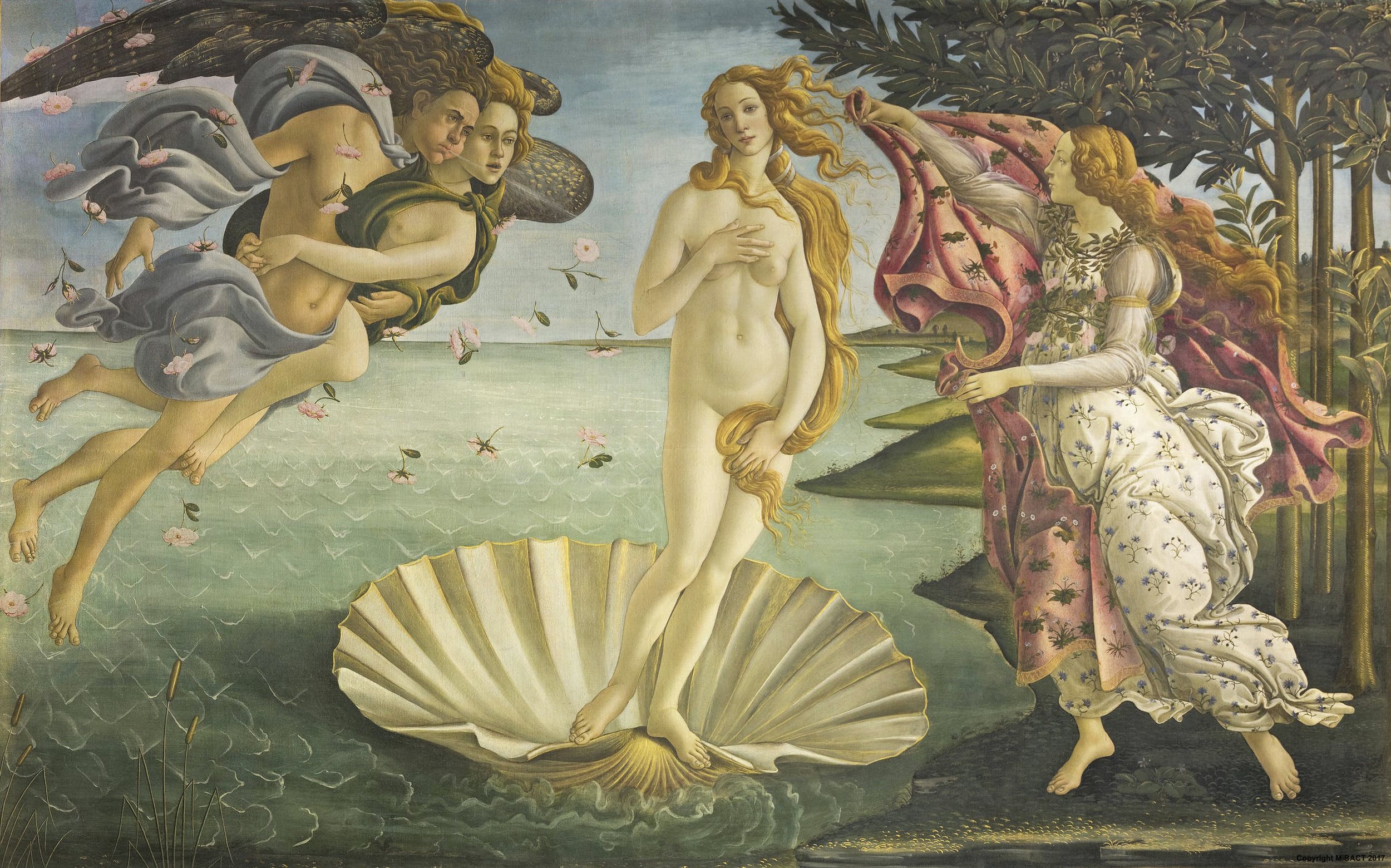
‘Nascita di Venere’, de Sandro Botticelli

Sandro Botticelli [c. 1445 – 17 Maio 1510]
“Nascimento de Vénus”, c. 1485 | Gallerie degli Uffizi, Florença

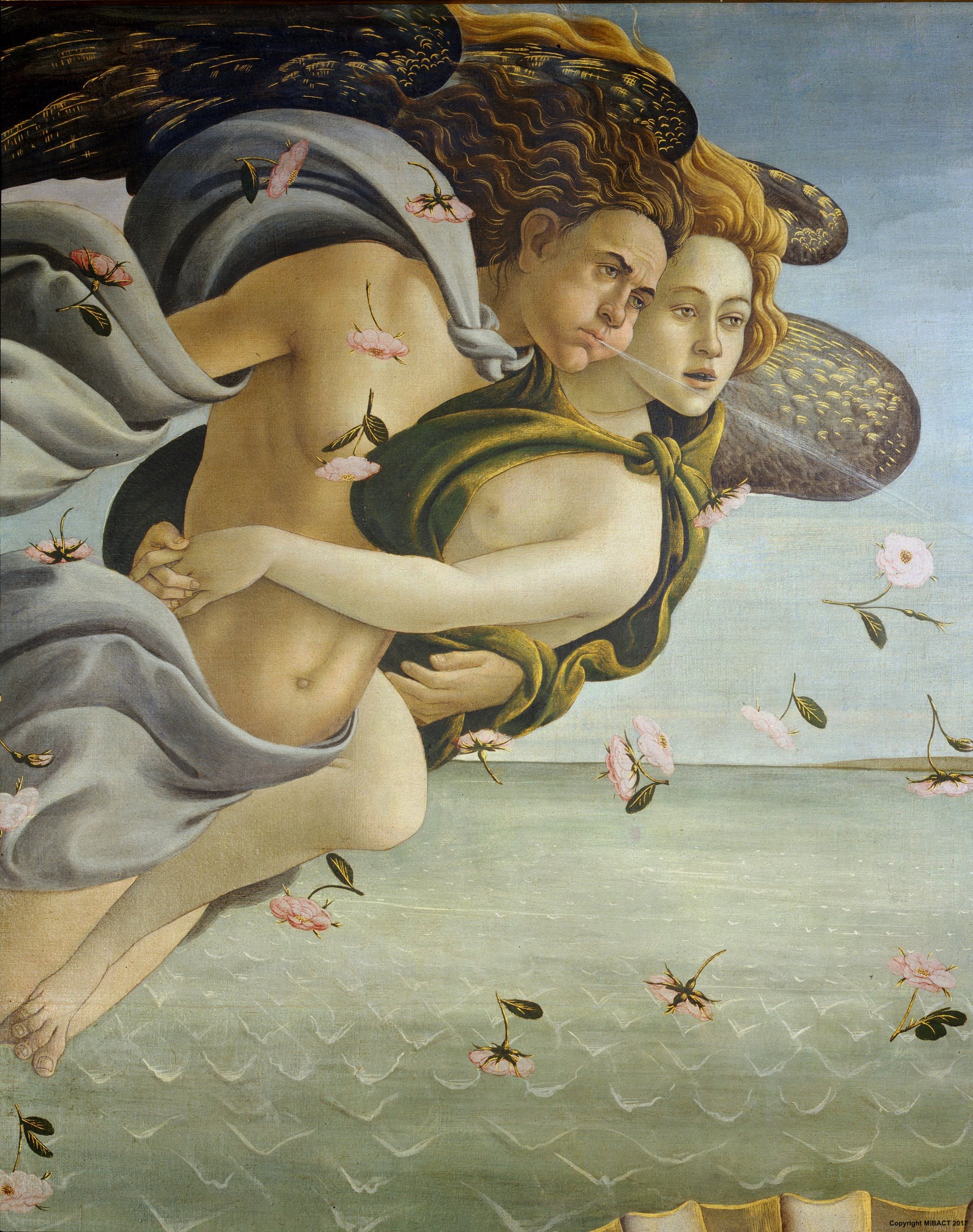
Known as the “Birth of Venus”, the composition actually shows the goddess of love and beauty arriving on land, on the island of Cyprus, born of the sea spray and blown there by the winds, Zephyr and, perhaps, Aura. The goddess is standing on a giant scallop shell, as pure and as perfect as a pearl. She is met by a young woman, who is sometimes identified as one of the Graces or as the Hora of spring, and who holds out a cloak covered in flowers. Even the roses, blown in by the wind are a reminder of spring. The subject of the painting, which celebrates Venus as symbol of love and beauty, was perhaps suggested by the poet Agnolo Poliziano.

It is highly probable that the work was commissioned by a member of the Medici family, although there is nothing written about the painting before 1550, when Giorgio Vasari describes it in the Medici’s Villa of Castello, owned by the cadet branch of the Medici family since the mid-15th century. This hypothesis would seem to be born out by the orange trees in the painting, which are considered an emblem of the Medici dynasty, on account of the assonance between the family name and the name of the orange tree, which at the time was ‘mala medica’.

Unlike the “Allegory of Spring”, which is painted on wood, the “Birth of Venus” was painted on canvas, a support that was widely used throughout the 15th century for decorative works destined to noble houses.

Botticelli takes his inspiration from classical statues for Venus’ modest pose, as she covers her nakedness with long, blond hair, which has reflections of light from the fact that it has been gilded; even the Winds, the pair flying in one another’s embrace, is based on an ancient work, a gem from the Hellenistic period, owned by Lorenzo the Magnificent.
Via Gallerie degli Uffizi.