‘Easter Morning’, de Caspar David Friedrich
Caspar David Friedrich [5 Setembro 1774 – 7 Maio 1840] – Easter Morning, c. 1828-1835
Museo Nacional Thyssen-Bornemisza, Madrid
Caspar David Friedrich [5 Setembro 1774 – 7 Maio 1840] – Easter Morning, c. 1828-1835
Museo Nacional Thyssen-Bornemisza, Madrid
O franco-flamengo Giaches de Wert, também conhecido como Jacques de Wert [1535-1596], foi um dos mais influentes compositores de madrigais do final do Renascimento. Ao serviço dos Duques de Mântua como maestro di cappella entre 1560 e 1592, recebeu em 1590 como violista o jovem Claudio Monteverdi [1567-1643], que acabara de publicar o seu II Livro de Madrigais.
Tendo-se fixado em 1888 em Doëlan, a escassos 20 km de Pont-Aven , Henry Moret [12 Dezembro 1856 – 5 Maio 1913] pintou Goulphar, Belle-île em 1895.
Esta obra integra-se na École de Pont-Aven, corrente artística agregadora de nomes que passaram pela costa da Bretanha durante a segunda metade do século XIX, dos quais se destaca Paul Gauguin.
Ketil Bjørnstad, pianista e compositor norueguês nascido em Oslo a 25 de Abril de 1952, teve a primeira gravação para a ECM em 1993 com Water Stories.
Em 1995, com David Darling no violoncelo, Terje Rypdal na guitarra e Jon Christensen na bateria, editou The Sea, o terceiro de quatro poemas aquáticos que gravou ao longo da década de 90.
J.M. William Turner [23 Apr 1775 – 19 Dec 1851]
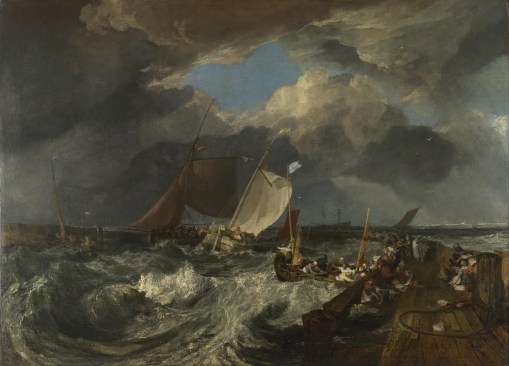
«Calais Pier, with French Poissards preparing for Sea: an English Packet arriving», 1803
Tate Gallery, London
A cross-channel ferry (a packet), fully laden with passengers and flying a British flag, is approaching the port of Calais. Around it, small French fishing boats (‘poissards’) head out to sea. The water is rough and dark storm clouds gather, although a shaft of sunlight breaks through to illuminate the white sail in the centre of the picture. In the lower right foreground, a small fishing boat is trying to get away to avoid being battered against the pier. The scene looks chaotic and there is a risk of collision.
Turner’s painting is based on an actual event he experienced, when he travelled from Dover to Calais in 1802 on his first trip abroad and was ‘nearly swampt‘ in a storm at sea. Although it had a mixed response when first exhibited at the Royal Academy in 1803, the critic John Ruskin declared it to be the first painting to show signs of ‘Turner’s colossal power’.