Terrina, de Tomás Brunetto
10 Obras de referência 2009 do Museu nacional de Arte Antiga | Visita guiada | Dia 25 de Novembro de 2009, 18:00
_____________________________________________

Terrina - Tomás Brunetto, 1767-1771 -MNAA
Arquivo por Autor
_____________________________________________
Terrina - Tomás Brunetto, 1767-1771 -MNAA
ISTANBUL. DIMITRIE CANTEMIR
“The Book of the Science of Music” and the Sephardic and Armenian musical traditions

“El libro de la ciencia de la música” y las tradiciones musicales sefardíes y armenias
_____________________________________________________________________
 En la encrucijada de dos continentes, el europeo y el asiático, ESTAMBUL para los otomanos, CONSTANTINOPLA para los bizantinos, es ya en la época de Dimitrie Cantemir (1673-1723) un verdadero hito de la historia; a pesar del recuerdo y la presencia muy evidente de la antigua Bizancio, se había convertido en el auténtico corazón del mundo religioso y cultural musulmán. Extraordinaria mezcla de pueblos y religiones, no deja de atraer a viajeros y artistas europeos; Cantemir desembarcó en la ciudad en 1693, a la edad de 20 años, primero como rehén y luego como representante diplomático de su padre, que gobernaba Moldavia. Se convirtió en un famoso intérprete de tanbur, una especie de laúd de mástil largo, y fue también un compositor muy apreciado por su obra Kitâb-ül ilm-il mûsikî (El libro de la ciencia de la música), que dedicó a sultán Ahmed III (1703-1730).
 El libro de la ciencia de la música de Dimitrie Cantemir, que nos ha servido de base como fuente histórica para nuestra grabación, es un documento excepcional en muchos aspectos; ante todo, como fuente fundamental de conocimiento de la teoría, el estilo y las formas musicales del siglo XVII, pero también como uno de los testimonios más interesantes sobre la vida musical de uno de los países orientales más importantes. Esa antología de 355 composiciones (de las cuales 9 pertenecen al propio Cantemir), escritas en un sistema de notación musical inventado por su autor, representa la más importante colección de música instrumental otomana de los siglos XVI y XVII que ha llegado hasta nuestros días. Empecé a descubrir ese repertorio en 1999 durante la preparación del proyecto sobre Isabel I de Castilla, cuando nuestro colaborador y amigo Dimitri Psonis, especialista en músicas orientales, nos propuso una antigua marcha guerrera de esa colección como ilustración musical de la fecha de la conquista de Constantinopla por parte de las tropas otomanas de Mehmed II.
Num magnífico documentário produzido pela BBC-Four, o actor Simon Russell Beale percorre o florescimento da música sacra ocidental, através da música de Thomas Tallis e William Byrd, dois compositores no centro do próprio Renascimento musical de Inglaterra, através das interpretações do Ensemble The Sixteen, dirigido por Harry Christophers.
Estamos de volta à dinastia dos Tudor (entre 1485 e 1603), período de grandes convulsões em torno da fé, posta em causa sempre que um novo monarca chega ao trono, culminando com o fim do Catolicismo Romano no reinado de Elizabeth I.
Profundamente consternado pelo seu desaparecimento.
500 Anos de História de um Arquipélago – Obras de Referência dos Museus da Madeira
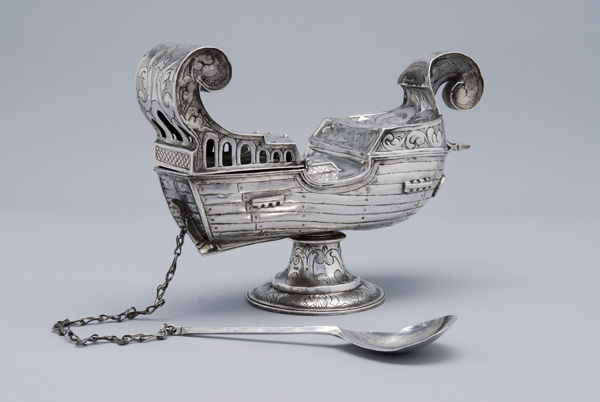
Naveta - Ourivesaria Portuguesa, Primeira metade do século XVII - Prata relevada e incisa, 15,8x23 - Museu Quinta das Cruzes

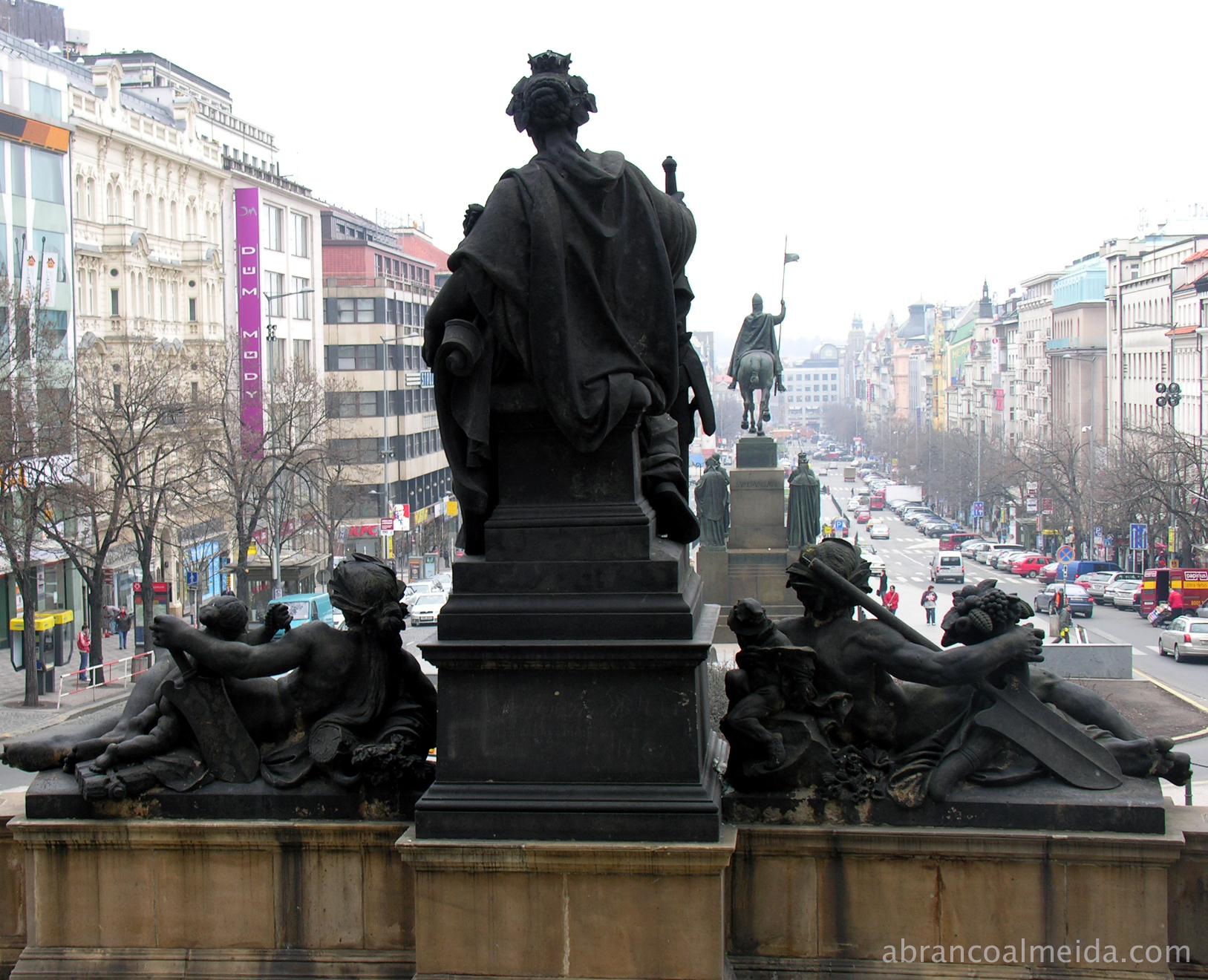
Prague, Spring 2006
“We’re unlocking the mysteries of our nearest neighbor and by extension the solar system. It turns out the moon harbors many secrets, and LCROSS has added a new layer to our understanding,” said Michael Wargo, chief lunar scientist at NASA Headquarters in Washington.
Scientists have long speculated about the source of vast quantities of hydrogen that have been observed at the lunar poles. The LCROSS findings are shedding new light on the question of water, which could be more widespread and in greater quantity than previously suspected.
Permanently shadowed regions could hold a key to the history and evolution of the solar system, much as an ice core sample taken on Earth reveals ancient data. In addition, water, and other compounds represent potential resources that could sustain future lunar exploration.
Since the impacts, the LCROSS science team has been working almost nonstop analyzing the huge amount of data the spacecraft collected. The team concentrated on data from the satellite’s spectrometers, which provide the most definitive information about the presence of water. A spectrometer examines light emitted or absorbed by materials that helps identify their composition.


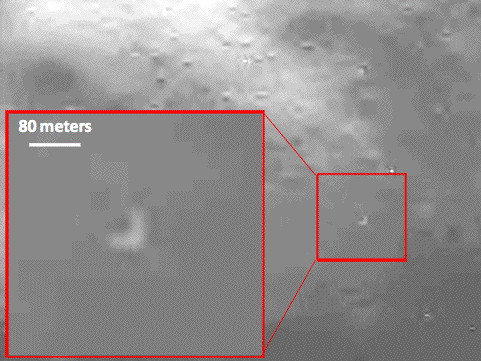

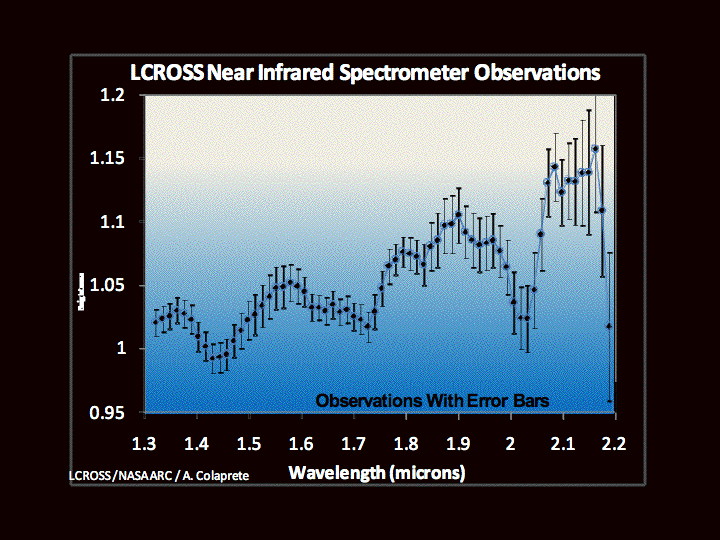

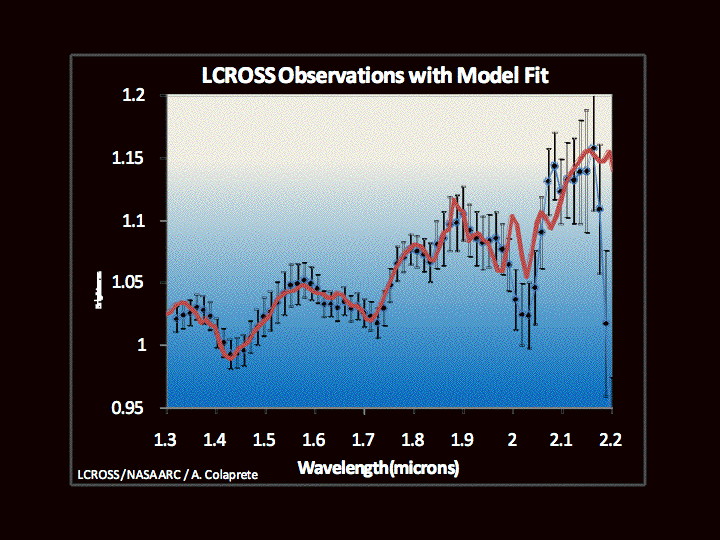


“We are ecstatic,” said Anthony Colaprete, LCROSS project scientist and principal investigator at NASA’s Ames Research Center in Moffett Field, Calif. “Multiple lines of evidence show water was present in both the high angle vapor plume and the ejecta curtain created by the LCROSS Centaur impact. The concentration and distribution of water and other substances requires further analysis, but it is safe to say Cabeus holds water.”
The team took the known near infrared spectral signatures of water and other materials and compared them to the spectra collected by the LCROSS near infrared spectrometer of the impact.
“We were only able to match the spectra from LCROSS data when we inserted the spectra for water,” said Colaprete. “No other reasonable combination of other compounds that we tried matched the observations. The possibility of contamination from the Centaur also was ruled out.”
Additional confirmation came from an emission in the ultraviolet spectrum that was attributed to hydroxyl, one product from the break-up of water by sunlight. When atoms and molecules are excited, they release energy at specific wavelengths that are detected by the spectrometers. A similar process is used in neon signs. When electrified, a specific gas will produce a distinct color. The ultraviolet visible spectrometer detected hydroxyl signatures just after impact that are consistent with a water vapor cloud in sunlight.
Data from the other LCROSS instruments are being analyzed for additional clues about the state and distribution of the material at the impact site. The LCROSS science team along with colleagues are poring over the data to understand the entire impact event, from flash to crater, with the final goal being the understanding of the distribution of materials, and in particular volatiles, within the soil at the impact site.
“The full understanding of the LCROSS data may take some time. The data is that rich,” said Colaprete. “Along with the water in Cabeus, there are hints of other intriguing substances. The permanently shadowed regions of the moon are truly cold traps, collecting and preserving material over billions of years.”
LCROSS was launched June 18, 2009 as a companion mission to the Lunar Reconnaissance Orbiter, or LRO, from NASA’s Kennedy Space Center in Florida. After separating from LRO, the LCROSS spacecraft held onto the spent Centaur upper stage rocket of the launch vehicle, executed a lunar swingby and entered into a series of long looping orbits around the Earth.
After traveling approximately 113 days and nearly 5.6 million miles (9 million km), the Centaur and LCROSS separated on final approach to the moon. Traveling as fast as a speeding bullet, the Centaur impacted the lunar surface shortly after 4:31 a.m. PDT Oct. 9 with LCROSS watching with its onboard instruments. Approximately four minutes of data was collected before the LCROSS itself impacted the lunar surface.
Working closely with scientists from LRO and other observatories that viewed the impact, the LCROSS team is working to understand the full scope of the LCROSS data. LRO continues to make passes over the impact site to give the LCROSS team additional insight into the mechanics of the impact and its resulting craters.
What other secrets will the moon reveal? The analysis continues!
Jonas Dino
NASA Ames Research Center
Partilhado com amigos especiais…


| S | T | Q | Q | S | S | D |
|---|---|---|---|---|---|---|
| 1 | 2 | 3 | 4 | 5 | ||
| 6 | 7 | 8 | 9 | 10 | 11 | 12 |
| 13 | 14 | 15 | 16 | 17 | 18 | 19 |
| 20 | 21 | 22 | 23 | 24 | 25 | 26 |
| 27 | 28 | 29 | 30 | |||


 Visita Guiada é um programa de televisão e de rádio que dá a conhecer o Património Cultural português.
 António Branco Almeida
 Ana Margarida Lopes

 O Universo Numa Casca de Noz