Arquivo por Autor

‘The Sea’, de Ketil Bjørnstad

Ketil Bjørnstad, pianista e compositor norueguês nascido em Oslo a 25 de Abril de 1952, teve a primeira gravação para a ECM em 1993 com Water Stories.
Em 1995, com David Darling no violoncelo, Terje Rypdal  na guitarra e Jon Christensen na bateria, editou The Sea, o terceiro de quatro poemas aquáticos que gravou ao longo da década de 90.


‘Belonging’, de Keith Jarrett

Produzido por Manfred Eicher para a ECM e gravado em Oslo entre os dias 24 e 25 de Abril de 1974, o álbum Belonging de Keith Jarrett conta com Palle Danielsson no baixo, Jon Christensen na bateria, Jan Garbarek no saxofone e Keith Jarrett no piano.

‘Calais Pier’, by William Turner

J.M. William Turner [23 Apr 1775 – 19 Dec 1851]
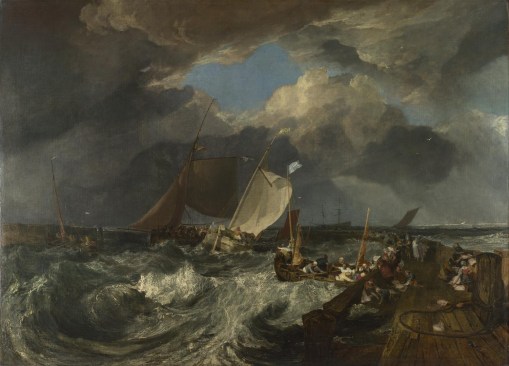
«Calais Pier, with French Poissards preparing for Sea: an English Packet arriving», 1803
Tate Gallery, London

A cross-channel ferry (a packet), fully laden with passengers and flying a British flag, is approaching the port of Calais. Around it, small French fishing boats (‘poissards’) head out to sea. The water is rough and dark storm clouds gather, although a shaft of sunlight breaks through to illuminate the white sail in the centre of the picture. In the lower right foreground, a small fishing boat is trying to get away to avoid being battered against the pier. The scene looks chaotic and there is a risk of collision.

Turner’s painting is based on an actual event he experienced, when he travelled from Dover to Calais in 1802 on his first trip abroad and was ‘nearly swampt‘ in a storm at sea. Although it had a mixed response when first exhibited at the Royal Academy in 1803, the critic John Ruskin declared it to be the first painting to show signs of ‘Turner’s colossal power’.

Concerto Grosso, de Giuseppe Torelli

Giuseppe Torelli [22 Abril 1658 – 8 Fevereiro 1709], violinista e compositor italiano do período barroco, foi contemporâneo de Tomaso Albinoni e Antonio Vivaldi na Península Itálica entre os séculos XVII e XVIII.
Do seu contributo para o desenvolvimento do Concerto Intrumental, a orquestra barroca Collegium Musicum 90, dirigida pelo violinista Simon Standage gravou em 2005 um disco de Concertos, do qual fica o primeiro andamento do Concerto Grosso para Violino em Fá Maior, Op. 8, No.11 – Allegro.


Trilogia de Monteverdi no Teatro La Fenice

No dia do 77º aniversário do maestro John Eliot Gardiner, boas notícias de Veneza, via Il Messaggero: o Teatro La Fenice disponibiliza a partir de hoje no seu canal no YouTube a trilogia de óperas de Monteverdi que sobreviveram até aos nossos dias, numa parceria com Monteverdi Choir & Orchestras e English Baroque Choir
Já disponível a partir de hoje 20 de Abril está «L’Orfeo» (1607); na próxima segunda-feira 27 de Abril chegará «Il ritorno d’Ulisse in patria» (1640) e na segunda-feira 4 de Maio «L’incoronazione di Poppea» (1643).


‘Aspheres’, by Jos d’Almeida

Aspheres, the third album from composer Jos d’Almeida, was released in 2019.
A new album is expected to be released in September 2020.


‘Do remember they can’t cancel the spring’, by David Hockney

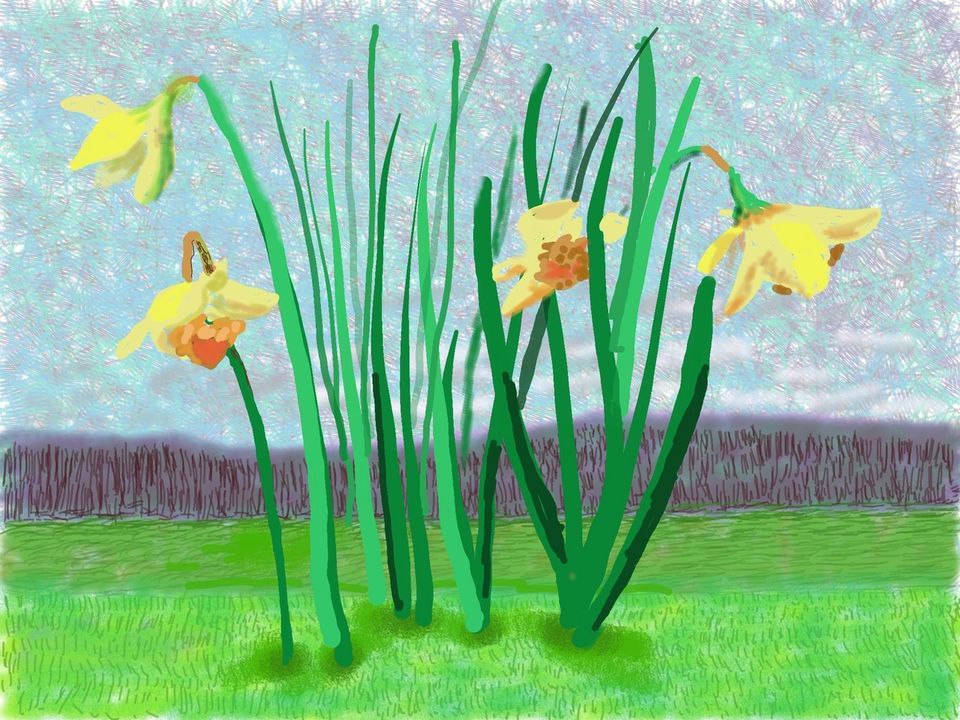
No dia 21 de Março, início da Primavera, o pintor inglês David Hockney (n. Bradford, 1937) brindou os seus concidadãos, através do jornal The Art Newspaper, com a oferta de um ramo de junquilhos (alguns chamam-lhe narcisos) desenhado no iPad na sua casa na Normandia, com o título Do remember they can’t cancel the spring (“Lembrem-se de que não se pode cancelar a Primavera”).Sérgio Andrade, Público de 18 Abril 2020


‘Vuelo de brujas’, de Francisco de Goya

De Francisco de Goya [30 Marzo 1746 – 16 Abril 1828] – “Vuelo de brujas”, 1798.

[…] Tres personajes, vestidos con faldillas, con el torso desnudo y tocados con capirotes en forma de mitra, decorados con pequeñas serpientes, e iluminados por un foco de luz exterior al cuadro, sostienen en el aire a otro desnudo, abandonado en sus brazos, al que insuflan aire soplando sobre su cuerpo, como revelan sus hinchadas mejillas. En la parte baja, dos hombres, vestidos de campesinos, han alcanzado la cima de la montaña, cuyo camino tortuoso y ascendente se pierde en la oscuridad del fondo, mientras su asno se ha parado más abajo. Uno, caído en el suelo, se tapa los oídos para no escuchar el ruido de los seres voladores; el otro, avanza con la cabeza cubierta, protegiéndose de la luz y haciendo la higa con sus dedos, contra el mal de ojo. […]

‘Human Proportion’, by Leonardo da Vinci

Leonardo da Vinci [15 April 1452 – 2 May 1519]
Text adapted from Leonardo da Vinci: A life in drawing, London, 2018


A nude man standing, facing the spectator, with arms outstretched. Another is kneeling beside him, to his right, so that his head just fits under the standing man’s arm; to the left of the main figure is a third man, seated, measured for proportion; with notes on human proportion on the left side of the sheet.


A four line note on human proportion c.1490


The system of human proportions in the central drawing on this sheet follows that set out in the treatise On Architecture by the Roman architect Vitruvius (first century bc). Accordingly, the height of the man is equal to the span of his outstretched arms; a quarter of his height is the cubit, marked off horizontally at the knees, pubis and between the armpits, and vertically at the elbows and down the centre of the chest. The same proportions are seen in Leonardo’s most famous drawing, the ‘Vitruvian man’ standing with arms outstretched in a square and circle (Venice, Accademia). The notes explain the two subsidiary diagrams: ‘if a man kneels he will diminish by a quarter part of his height’, and ‘the umbilicus is [then] the middle of his height’; and ‘the middle of a man who sits […] is below the breast and below the shoulder’. Via.

‘Messiah’, de George Frideric Handel

De George Frideric Handel [1685–1759], compositor e instrumentista alemão naturalizado inglês, a maravilhosa peça ‘For unto us a child is born’, extraída da primeira parte da oratória “O Messias”, HWV 56.
A obra, concebida sobre libreto de Charles Jennens, teve a sua estreia no Great Music Hall em Dublin, no dia 13 de Abril de 1742.
Handel ainda dirigiu “O Messias” no Convent Garden dias antes da sua morte, a 14 de Abril de 1759.

Solistas: Carolyn Sampson, soprano | Catherine Wyn-Rogers, contralto
Mark Padmore, tenor | Christopher Purves, baixo
Acompanhados pelo agrupamento The Sixteen, dirigidos por Harry Christophers.