‘At the Races’, de Édouard Manet
De Édouard Manet [23 Janeiro 1832 – 30 Abril 1883], ‘At the Races’, c. 1875.
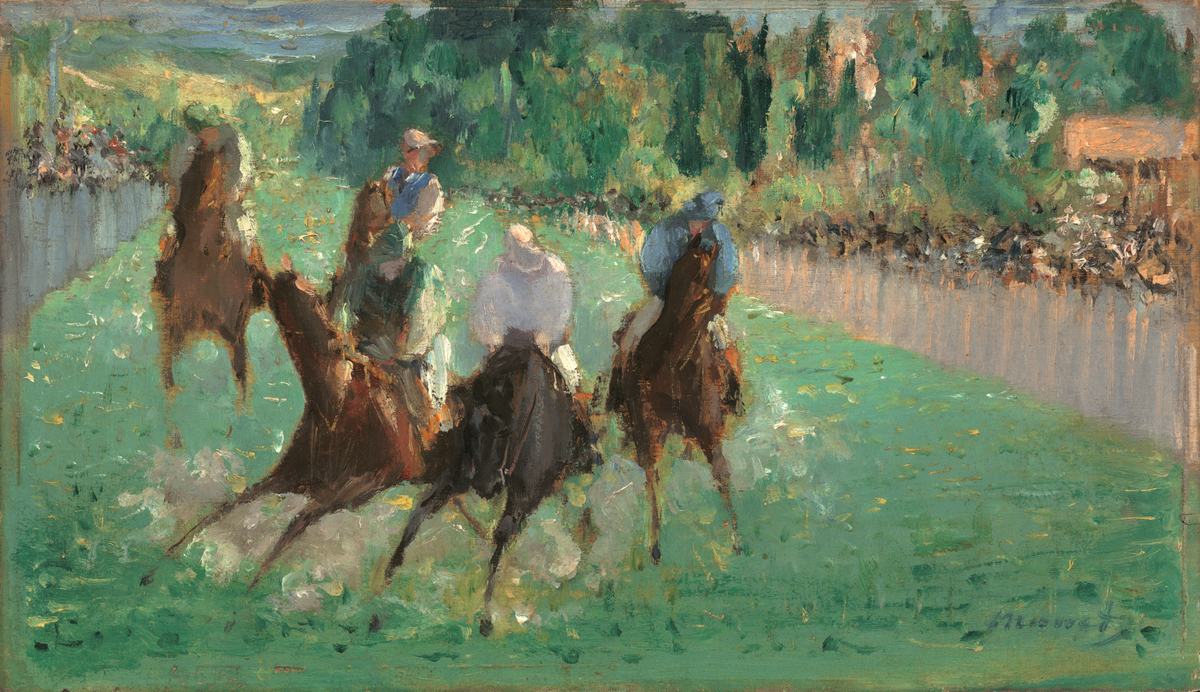
Édouard Manet – ‘At the Races’, c. 1875
National Gallery of Art (não está em exibição)
Archive for the ‘ Museus ’ Category
De Édouard Manet [23 Janeiro 1832 – 30 Abril 1883], ‘At the Races’, c. 1875.
Édouard Manet – ‘At the Races’, c. 1875
National Gallery of Art (não está em exibição)
De Jean-François Millet [4 Outubro 1814 – 20 Janeiro 1875], pintor francês fundador da Escola de Barbizon que contribuiu para a elaboração de um novo naturalismo, ‘O Inverno’, de 1868.

Jean-François Millet [1814-1875] – ‘O Inverno’, c.1868
Museu Calouste Gulbenkian (em reserva)
O pastel representa uma paisagem invernosa, com uma planície gelada a estender-se até ao limite do horizonte, colocado num ponto de vista elevado. Duas linhas de fuga bem definidas conduzem o olhar do observador até ao mais próximo de três montes de feno. A sugestão de atmosfera húmida estende-se por toda a superfície da composição. Quase imperceptível, à direita, vislumbra-se um caçador, pormenor que remete o observador para o tema fulcral da obra de Millet: a relação homem/meio.
Via Museu Gulbenkian.
From Paul Cézanne [19 January 1839 – 22 October 1906], The Bathers, 1899/1904

Paul Cézanne – The Bathers, 1899/1904
The Art Institute of Chicago
Through his studies of groups of bathers outdoors, Paul Cézanne reconceived a classical subject in a modern, pictorial idiom. Though clearly related, The Bathers is not a study for either of the monumental canvases of bather subjects that the artist left unfinished at his death; rather, it is an independent, exploratory work painted with a more spritely touch. For all its compositional complexity, it retains the lightness of a watercolor, with thin parallel strokes and dashes and areas of white-primed canvas showing through the paint.
Contemporâneo dos impressionistas, o pintor francês Henri Fantin-Latour [14 Janeiro 1836 – 25 Agosto 1904] teve um percurso mais romântico através dos temas florais, naturezas-mortas, retratos familiares e de intelectuais da época. A obra do período simbolista ‘La tentation de saint Antoine’ – 1897, pertence ao Petit Palais em Paris.

Henri Fantin-Latour (1836-1904). “La tentation de Saint Antoine”, 1897. Musée des Beaux-Arts de la Ville de Paris, Petit Palais.
De Jose de Ribera (Lo Spagnoletto) [12 Jan 1591 – 2 Set 1652] – La Piedad, 1633

José de Ribera – La Piedad, 1633
Museo Nacional Thyssen-Bornemisza, Madrid
“Man has tasted of the fruit of the tree of knowledge, and now his intellect reveals to his astonished gaze the abstract reality of creation”.
“Isaac Newton”, born on 4 January 1643, by William Blake [1757-1827]

Newton 1795-c. 1805 William Blake 1757-1827 Presented by W. Graham Robertson 1939 http://www.tate.org.uk/art/work/N05058
De August Macke [3 Janeiro 1887 – 26 Setembro 1914], Hussardos a galope de 1913.

Museo Thyssen- Bornemisza
De Piero di Cosimo [2 Janeiro 1462 – 12 Abril 1522], pintor do Quattrocento italiano, também conhecido como Piero di Lorenzo, Liberazione di Andromeda, c. 1510–1513 – Galleria degli Uffizi, Florença.

Piero di Cosimo, Liberation of Andromeda, c. 1510–1513 – Galleria degli Uffizi, Florence
Max Beckmann [Leipzig, 12 Fevereiro 1884 – Nova Iorque, 27 Dezembro 1950], pintor associado ao expressionismo alemão, completou ‘Os Argonautas’ no dia da sua morte. Em 2018, Antonio Muñoz Molina escreveu para o El País um artigo sobre o grande cronista da Alemanha do século XX.

Merry Christmas with Jan Gossaert‘s ‘The Adoration of the Kings’


 Visita Guiada é um programa de televisão e de rádio que dá a conhecer o Património Cultural português.

 António Branco Almeida
 Ana Margarida Lopes