Em 29 de Maio de 1453, a capital do Império Bizantino, Constantinopla (Istambul), cai às mãos do Império Otomano, apagando assim os últimos vestígios do Império Romano. Em 1508, Albrecht Dürer ilustrou a barbárie turca com este “Massacre dos dez mil cristãos”.
Albrecht Dürer – ‘Marter der zehntausend Christen’, 1508
Kunsthistorischen Museum, Viena
On 23 May 1533, The Archbishop of Canterbury Thomas Cranmer, sitting in judgment at a special court convened at Dunstable Priory to rule on the validity of King Henry VIII’s marriage to Catherine of Aragon, declared the marriage of Henry and Catherine null and void. Five days later, on 28 May 1533, Cranmer declared the marriage of Henry and Anne Boleyn to be valid.
And then they lived happily ever after… until Anne Boleyn was executed on 19 May 1536…!
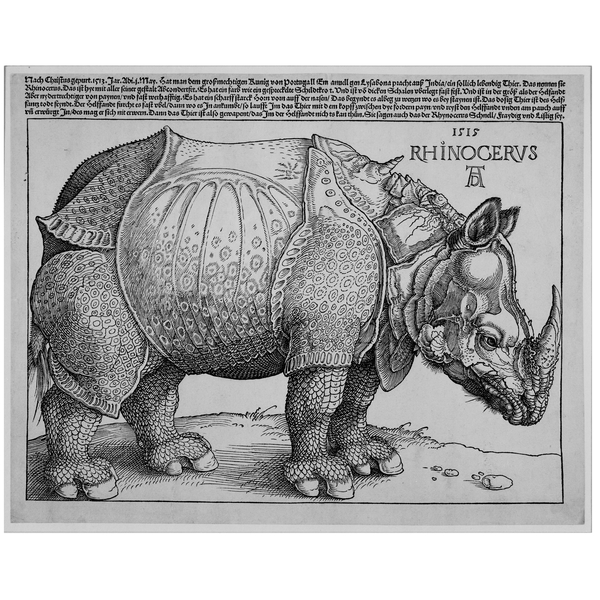
This celebrated woodcut records the arrival in Lisbon of an Indian rhinoceros on 20 May 1515.
The ruler of Gujarat, Sultan Muzafar II (1511-26) had presented it to Alfonso d’Albuquerque, the governor of Portuguese India. Albuquerque passed the gift on to Dom Manuel I, the king of Portugal. The rhinoceros travelled in a ship full of spices.
On arrival in Lisbon, Dom Manuel arranged for the rhinoceros to fight one of his elephants (according to Pliny the Elder’s Historia Naturalis (‘Natural History’) (AD 77), the elephant and rhinoceros are bitter enemies). The elephant apparently turned and fled.
A description of the rhinoceros soon reached Nuremberg, presumably with sketches, from which Dürer prepared this drawing and woodcut.
No rhinoceros had been seen in Europe for over 1000 years, so Dürer had to work solely from these reports. He has covered the creature’s legs with scales and the body with hard, patterned plates. Perhaps these features interpret lost sketches, or even the text, which states, ‘[The rhinoceros] has the colour of a speckled tortoise and it is covered with thick scales’.
So convincing was Dürer’s fanciful creation that for the next 300 years European illustrators borrowed from his woodcut, even after they had seen living rhinoceroses without plates and scales.
Dom Manuel sent the rhinoceros to Pope Leo X in Rome, who had much admired ‘Hanno’, the elephant the king had sent him the year before. Sadly, the ship carrying the new gift sank before it reached Rome. Via British Museum.
In 1515, he created his woodcut of a Rhinoceros which had arrived in Lisbon from a written description and sketch by another artist, without ever seeing the animal himself. An image of the Indian rhinoceros, the image has such force that it remains one of his best-known and was still used in some German school science text-books as late as last century. Via Wikipedia.
Banda sonora de Vangelis para o filme “1492 – The Conquest of Paradise”, de Ridley Scott. Venturas e desventuras de Cristóvão Colombo, falecido a 20 de Maio de 1506, protagonista de uma das maiores aventuras dos últimos 500 anos.
Formado em Junho de 2004, o Mediae Vox Ensemble tem como objectivo o estudo e a interpretação da música sacra medieval. As suas interpretações têm exclusivamente por base e suporte os manuscritos e as notações originais; Composto pelas cantoras e instrumentistas Carolina Figueiredo, Manon Marques, Mariana Moldão e Filipa Taipina, utilizou réplicas de instrumentos da Idade Média e apresentou o seguinte programa:
Ave Generosa, Hildegard von Bingen [1098-1179] – (Wiesbaden, Landesbibliothek , Riesenberg Codex) Ecce Virgo (Graduale Triplex – Stiftsbibliothek 121) Puisque Voi La Fleur Novel, Gauthier de Coincy [1178-1236] – Les Miracles de Nostre Dame – Bibliothèque Nationale de France, Départemente de manuscrits, NAF 24541) Congaudeat (Engelbert Stiftsbibliothek Codex 314) Hodie aperuit, Hildegard von Bingen [1098-1179] – (Dendermond, St. Pieters & Paulusabdij Cod.9) Sante Marie Viergene, San Godric di Finchal [1080-1170] – (British Museum Lib., MS Royal 5F) Hec est mater – Tropo Benedicamus (Engelbert Stiftsbibliothek Codex 314) Salve Regina (Antiphonale Monasticum) Rosa Fragrans (Oxoford, Corpus Christi College MS B 489) Sante Marie Viergene, San Godric di Finchal [1080-1170] – (British Museum Lib., MS Royal 5F) Prima Cedit Femina (Bamberg, Staatbibl., Ms Lit. 115) Agnus Dei – Ave Maria – Tropo Agnus Dei (Engelbert Stiftsbibliothek Codex 314) Ave mutter kuniginne/Ave mater, Oswald von Wolkenstein [1375-1457] – (Engelbert Stiftsbibliothek Codex 314)
«Sem os sentidos não há memória e sem a memória não há inteligência.»
Voltaire, A Aventura da Memória e Outros Contos, 1773
Festival Monteverdi – Vivaldi | Concerto Inaugural – 01 Jun 2013 Mare Nostrum – Diálogo entre música veneziana, otomana, árabe-andaluza, sefardita e arménia da bacia do Mediterrâneo
Lior Elmaleh & Irini Derebei (voz) | Hesperion XXI & Jordi Savall
David Hockney 25 Fondation Louis Vuitton Du 09/04/25 au 31/08/25
Artemisia - Héroïne de l'art Musée Jacquemart-André À partir du 19 mars 2025
Join the celebrations for JMW Turner’s 250th anniversary in 2025 Tate Britain, London
Guest House
1.167.318 visitors
Calendário Cósmico
Fevereiro 2026
S
T
Q
Q
S
S
D
1
2
3
4
5
6
7
8
9
10
11
12
13
14
15
16
17
18
19
20
21
22
23
24
25
26
27
28
Jos d’Almeida
Jos d'Almeida é um compositor de música electrónica épico sinfónica, podendo este género ser também designado como Electrónico Progressivo. Na construção de um som celestial, resultante da fusão de várias correntes musicais, JOS utiliza os sintetizadores desde o início dos anos 80.
Chuck van Zyl
Chuck van Zyl has been at his own unique style of electronic music since 1983. His musical sensibilities evoke a sense of discovery, with each endeavor marking a new frontier of sound.