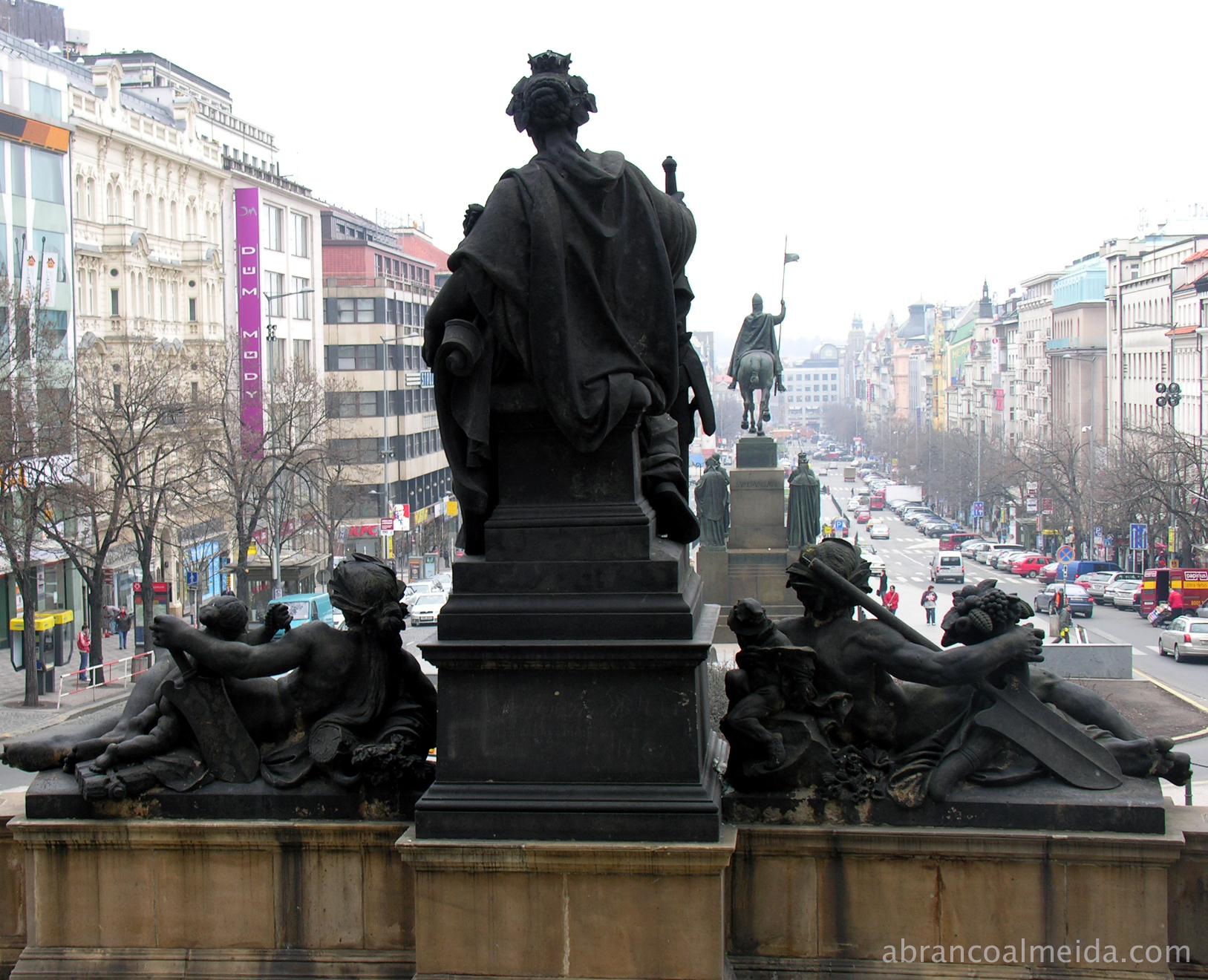
In the space of just a few weeks in November 1989, the Communist system in Czechoslovakia was brought to its knees. Massive protests on the streets of Prague – often several hundred thousand strong – forced the resignation of the hard-line Communist Party leadership in what became known as “the velvet revolution.”
One of the names the demonstrators shouted was that of Alexander Dubcek. He was the leader of the famous “Prague Spring” in 1968 when attempts at reform were crushed by Soviet tanks. He made a triumphant return to Prague after years in political oblivion.
On November 17, 1989, a Friday, riot police suppressed a peaceful student demonstration in Prague. That event sparked a series of popular demonstrations from November 19 to late December. By November 20 the number of peaceful protesters assembled in Prague had swollen from 200,000 the previous day to an estimated half-million.
The real man of the hour, though, was Vaclav Havel, the playwright who was one of the leaders of the dissident Charter 77 movement. An outspoken critic of the Communists, he had spent time in prison for his beliefs. After the collapse of the Communists, he was unanimously elected President of Czechoslovakia.
Unlike some of its East European neighbours, Czechoslovakia was relatively successful economically following the fall of Communism. The most dramatic change has been in the transformation from a centralised state-controlled economy to a capitalist system. Almost 80% of industry and commerce is now in private hands.
1989 was a momentous year for eastern Europe. It was the year the Berlin Wall finally came down as pressure for reform grew in East Germany. And in Romania, the Ceascescu dictatorship, which had tried to resist the winds of change blowing elsewhere, was overthrown in a bloody uprising. Via.
Our collaboration was five years old when we returned to the monastery of St Gerold. We wanted to do two things: record versions of some of the new music that we had added to our repertoire sinceOfficium, and renew our encounter with the unknown, experimenting with music we hadn’t come across before. Officiumwas based broadly on early music principles; we have now performed together hundreds of times and the repertoire, and what we do with it, has evolved a long way from those first explorations. So Mnemosynereally contains two sorts of music. The most straightforward are those pieces where we sing existing music (conventionally notated) and the saxophone improvises around us. We may reorder the music a bit but we know more or less what we’re going to do (we never know what the saxophone is going to do … ). This was how much of Officium worked.
A lot of the newer repertoire on Mnemosyneconsists of very small amounts of material with minimal notation. These are rarely complete pieces and often just a few scraps, recovered from old book bindings or buried for centuries under desert sands. We may decide on an outline form and share out the material, then we all improvise and none of us knows what will happen next. It was another magical experience for us, five musicians plus the mercurial creative impulse of Manfred Eicher, and the timeless hospitality of Pater Nathanael at St Gerold. We did it for each other, in the absence of an audience, and these are complete, one-off performances, which will never sound the same again. John Potter
The Hilliard Ensemble David James, countertenor Rogers Covey-Crump, tenor John Potter, tenor Gordon Jones, baritone Jan Garbarek, soprano & tenor saxophones
Mnemosyne
A sign we are, inexplicable
Without pain we are and have nearly
Lost our language in foreign lands.
For when the heavens quarrel
Over humans and moons proceed
In force, the sea
Speaks out and rivers must find
Their way. But there is One,
Whitout doubt, who
Can change this any date. He needs
No law. The rustle of leaf and then the sway of oaks
Besides glaciers. Not everything
Is in the power of the gods. Mortals would sooner
Reach toward the abyss. With them
The echo turns. Though the time
Be long, truth
Will come to pass.
“Officium” – “Parce Mihi Domine” (Cristóbal de Morales, 1550-1553, Spain). Recorded at Propistei St. Gerold, Austria (Sept. 1993). “Parce mihi Domine” is from the vulgate translation of the Book of Job. The whole text is beautiful and Morales has created a truly transcendent piece here, very much ahead of his time: “Spare me, Lord, for my days are as nothing.
What is Man, that you should make so much of us?
Or why should you set your heart upon us?
You visit us at dawn,
and put us to the test at any moment.
Will you not spare me and let me be,
while I swallow my saliva?
If I have sinned, how have I hurt you,
O guardian of mankind?
Why have you set me up as your target,
so that I am now a burden to myself?
Why do you not forgive my sin
and why do you not take away my guilt?
Behold, I shall now lie down in the dust:
if you come looking for me I shall have ceased to exist.”
Patrick Joseph Cowley (19-10-1950 / 12-11-1982), compositor de música discoe Hi-NRG(High Energy)cujo estilo é frequentemente comparado ao de Giorgio Moroder e a quem é atribuído o pioneirismo na música de dança electrónica, conheceu Sylvesternos finais da década de 70, com quem se juntou em estúdio para gravar You Wanna Funk. Muito popular na cena gay no início da década de 80 foi o seu hit Menergy. A minha faixa preferida será sempre Megatron, cujo vinil ainda hoje me arrependo de ter oferecido! 😦
Patrick Cowley – Menergy, 1981
Sylvester & Patrick Cowley – Do You Wanna Funk
Patrick Cowley – Megatron Man, 1981
Patrick Cowley – I Wanna Take You Home, 1981
I Feel Love (Donna Summer) – Remix de Patrick Cowley, 1982
Quinta, 12 Novembro | 22h00 | Música | Grande Auditório | Kind of Blue @ 50
Jimmy Cobb´s so what Band Featuring Wallace Roney, Vincent Herring, Javon Jackson, Larry Willis & Buster Williams
Editado em 1959 pelo lendário trompetista Miles Davis (1926-1991) e tido por muitos como uma verdadeira obra-prima da história do jazz, o álbum “Kind of Blue” cumpre este ano meio século de existência.
Em homenagem a este acontecimento, o famoso baterista Jimmy Cobb, único elemento ainda vivo da formação original da gravação, decidiu recordar a edição do disco, realizando uma série de concertos com uma formação que conta com a colaboração de um importante conjunto de músicos – Wallace Roney, Javon Jackson, Vincent Herring, Larry Willis e Buster Williams.
Ao mesmo tempo, surge no mercado uma edição comemorativa que inclui 2 CDs com a totalidade dos takes gravados no momento do seu registo discográfico, incluindo ainda um livro com textos e fotos, um documentário em DVD sobre “Kind of Blue” e um LP com a edição original do trabalho. “Kind of Blue” foi um dos discos mais vendidos de sempre, uma obra fundamental, olhado por muitos como o trabalho mais importante em toda a história do jazz. Em 2003 foi eleito pela revista “Rolling Stone” o 12º melhor álbum de todos os tempos (entre 500 títulos seleccionados), não sendo por isso de admirar que tenha tantas vezes sido considerado um álbum imprescindível em qualquer discografia. Nesse ano fantástico de 1959, durante o qual aconteceram grandes momentos musicais, importantes contributos para a consolidação de uma corrente estética e musical que haveria de ser essencial na afirmação definitiva do jazz, “Kind of Blue” juntava na 30th Street, Nova Iorque, nos estúdios da Columbia Records, alguns dos maiores improvisadores do século XX: Miles Davis (trompete), John Coltrane (saxofone tenor), Bill Evans (piano, excepto em “Freddie Freeloader” – Wynton Kelly), Paul Chambers (contrabaixo), Cannonball Adderley (saxofone alto) e Jimmy Cobb (bateria). A primeira sessão deu origem ao lado A do disco e decorreu a 2 de Março, gravando-se “So What”, “Freddie Freeloader” e “Blue in Green”. Um mês depois, a 22 de Abril, estes músicos voltaram a reunir-se para registarem “Flamenco Sketches” e “All Blues”.
Produzido por Teo Macero, “Kind of Blue” é a soma de muitas genialidades: as de Miles Davis associadas às espantosas qualidades artísticas de cada um dos músicos presentes que revelaram uma da capacidade de improvisação fora de comum para a época. Segundo Jimmy Cobb, “Kind of Blue” foi “feito no céu”. Segundo a opinião insuspeita do pianista Herbie Hancock, o disco é um acontecimento raro, uma junção de energias que se transformaram n’ “Um marco não só da história do jazz, mas também da história da música”.
______________________________
Sexta, 13 Novembro | 22h00 | Música | Grande Auditório | Hank Jones Trio
Aos 91 anos, Hank Jones é uma lenda viva do jazz. A sua carreira é feita de sete décadas como pianista e compositor com centenas de discos gravados, quer acompanhando os mais variados tipos de artistas, quer como líder, registando mais de sessenta trabalhos.
Primogénito de sete irmãos, nasceu em 1918, no estado do Mississippi, no contexto de uma família destinada a ter uma profunda relação com o jazz. É irmão do famoso baterista Elvin Jones e do trompetista e compositor Thad Jones, infelizmente já desaparecidos. Hank Jones foi um dos grandes impulsionadores do bebop e tocou com quase todos os grandes nomes da história do jazz como Coleman Hawkins, Ella Fitzgerald, Charlie Parker, Max Roach, Artie Shaw, Benny Goodman, Lester Young, Cannonbal Adderley, John Coltrane, Wes Montgomery, John Lewis, Tommy Flanagan, Ron Carter, Gato Barbieri, Eddie Gomez, Al Foster, Sonny Stitt, Oscar Peterson, Charlie Haden e Joe Lovano. Durante a sua carreira acompanhou Ella Fitzgerald, assim como Frank Sinatra e Diana Krall. Muito poucos deverão saber que Hank Jones foi o pianista que acompanhou Marilyn Monroe quando esta cantou o célebre “Happy Birthday Mr. President” a John F. Kennedy.
Apesar de ter pensado em reformar-se em 1987, Hank Jones continua activo e prolífico, tocando pelo mundo inteiro, gravando e dirigindo masterclasses em inúmeras universidades, como Harvard ou Nova Iorque. O mundo confirma-o como um dos últimos sobreviventes daquele núcleo de músicos excepcionais que ajudaram a consolidar o jazz em todas as partes do planeta. Para além de muitos outros prémios e homenagens, recebeu o título de Master of Jazz, atribuído pelo National Endowment for The Arts – um prémio que consagra a sua dedicação e paixão por esta música. Neste concerto, Hank Jones sobe ao palco acompanhado por dois intérpretes de excepção: George Mraz e Willie Jones III.
Branford Marsalis é um prestigiado saxofonista, um homem que se movimenta por dentro de inúmeros interesses musicais do jazz, blues e funk, a projectos de música clássica como o conhecido Marsalis Brasilianos, a partir da exploração do imaginário musical de Heitor Villa-Lobos.
Três vezes galardoado com um Grammy, tem desenvolvido a sua carreira como instrumentista de excepção, compositor dotado e director da Marsalis Music, uma editora por si fundada em 2002, através da qual tem produzido os seus próprios projectos, assim como os de artistas jovens, considerados novos talentos em ascensão do mundo do jazz. Oriundo de Nova Orleães, Branford Marsalis nasceu em 1960, no seio de uma família, considerada uma das maiores referências musicais da cidade: o patriarca/pianista/professor Ellis Marsalis e os seus filhos Wynton, Delfeayo e Jason. Começou a adquirir notoriedade quando integrou os Art Blakey’s Jazz Messengers e participou em inúmeros concertos com o quinteto do irmão Wynton Marsalis, no início dos anos 80, antes mesmo de ter formado o seu próprio grupo. Acompanhou e gravou com grandes lendas da história do jazz, como Miles Davis, Dizzy Gillespie, Herbie Hancock e Sonny Rollins. Conhecido pelo seu espírito inovador e pela sua visão musical muito abrangente no que diz respeito aos géneros, estilos e tipos de música, a sua actividade tem vindo a ampliar-se nos últimos anos, tendo-se tornado um solista de referência nas famosas orquestras sinfónicas de Chicago, Detroit, Dusseldorf e Carolina do Norte. Os seus interesses diversificados reflectem a sua cultura e as muitas actividades que tem realizado nos mais diversos contextos. Passou dois anos em digressão, tendo gravado com Sting e foi director musical do “The Tonight Show with Jay Leno”. Durante dois anos, colaborou com os Grateful Dead e Bruce Hornsby, participou nos filmes “Throw Mama from the Train” e “School Daze”, fez a banda sonora para “Mo’ Better Blues”, entre outros filmes, e foi o anfitrião do programa Jazz Set da National Public Rádio. O seu último CD, “Metamorphosen”, lançado em Março deste ano, assinala o 10º aniversário do quarteto de Branford Marsalis, um dos grupos mais poderosos e inventivos do jazz actual. Este grupo trabalha a improvisação como um bloco de sonoridades, retirando ideias de todos os géneros de música. Este conjunto de instrumentistas está junto há muitos anos e é capaz de criar, em simultâneo, formas antagónicas de estruturação musical que nalguns momentos surgem extremamente enérgicas, noutros intensamente melódicos.
Os meus destaques foram obtidos na página oficial do Guimarães Jazz 2009, onde se pode consultar a totalidade da programação.
Constituindo a etapa mais fecunda e gloriosa das Artes e das Letras em Espanha, o período compreendido entre o Renascimento e o Barroco, isto é, o Siglo de Oro, estendeu-se ao longo de quinhentos e seiscentos. Nessa época a ficção do país vizinho alcançaria o apogeu de universalidade e expressão com o “Dom Quixote”, a obra-prima de Miguel de Cervantes, e outros géneros literários onde sobressaem as obras picarescas Lazarillo de Tormes, de autor anónimo, cuja edição mais antiga data de 1554, concebida em forma de autobiografia e num estilo epistolar como se de uma longa missiva se tratasse, e Guzmán de Alfarache, publicada, em duas partes, na viragem do século, da autoria de Mateo Alemán, escritor que estabeleceu e consolidou as suas tipologias características. Além disso, foi também a época dourada da poesia, visto Juan Boscán e Garcilaso de la Vega terem adaptado o género lírico transalpino ao castelhano e proporcionado que a sua expressão máxima fosse conseguida na prosa de Santa Teresa de Ávila e na poesia mística de Frei Luis de León e São João da Cruz. João Chambers. Para ouvir no Musica Aeterna de hoje.
Em 1521, vive-se o início perturbado dum grande império que abre à Espanha as portas da Europa renascentista e impregnada pelas ideias da Reforma, em guerra com a França, por rivalidade na disputa do trono da Alemanha.
Com o poeta Juan Boscán, a quem ficará ligado na sua vida e na sua obra, desde o seu desenvolvimento até à sua publicação póstuma, Garcilaso participou na defesa da ilha de Rodas, atacada pelos turcos, em 1522.
O período mais fecundo da sua obra corresponde aos anos de 1533-36, quando Garcilaso, em Nápoles e relacionado com poetas e humanistas italianos, tinha assimilado por completo o espírito e o sentido artístico do Renascimento.
No verão de 1535, Garcilaso tomou parte na expedição do Imperador carlos V a Tunes: foi ferido em combate, o que não o impediu de participar no ataque a fortaleza da Goleta. In “Garcilaso de la Vega – Antologia Poética”, de José Bento
SONETO XXXIII – A BOSCÁN DESDE LA GOLETA
Boscán, las armas y el furor de Marte,
que con su propria fuerza el africano
suelo regando, hacen que el romano
imperio reverdezca en esta parte,
han reducido a la memoria el arte
y el antiguo valor italïano,
por cuya fuerza y valerosa mano
África se aterró de parte a parte.
Aquí donde el romano encendimiento,
donde el fuego y la llama licenciosa
solo el nombre dejaron a Cartago,
vuelve y revuelve amor mi pensamiento,
hiere y enciende el alma temerosa,
y en llanto y en ceniza me deshago.
Neste The Musiciansdo pintor Caravaggio (1571-1610) – de quem no próximo ano se assinalam os quatrocentos anos da morte -, as duas figuras vistas de frente são indubitavelmente retratos, o que limita uma análise convencional da cena no âmbito nobre e clássico da composição, centrada entre a figura do tocador de alaúde e a figura recuada. O rosto entre ambos é de Caravaggio e figura da esquerda é de uma composição anterior (Jovem descascando uma pêra) da qual só existem cópias.
Caravaggio – The Musicians, 1595-96 (Metropolitan Museum of Art, New York)
Para acompanhar, um Madrigal de Thomas Morley (1557 – 1602), músico e organista inglês do período renascentista.
Com a divulgação do excepcional Documentário de 2005 Keith Jarrett – The Art Of Improvisation percorro alguns dos meus favoritos discos de Jarrett, que incluem um conjunto notável de amigos que há muitos anos o acompanham nesta viagem: Jack DeJohnette, Gary Burton, Gary Peacock, Charles Lloyd e Manfred Eicher.
Por via de uma profunda pesquisa da vida e trabalho de Keith Jarrett, o Documentário resulta numa excepcional oportunidade para entender os contrastes entre o jazz e a música clássica; Contém uma enorme quantidade de material de arquivo, enriquecido com detalhes das entrevistas filmadas com Keith, e testemunhos de quem com ele colaborou durante anos: familiares, managers e outros colaboradores próximos, como Steve Cloud, Scott Jarrett, George Avakian, Miles Davis, Toshinari Koinuma, Charlie Haden, Dewey Redman, Rosa Anne Jarrett, Jan Garbarek e John Christensen. Este Documentário expõe o talento único do artista que explora as fronteiras do jazz e que lhe proporciona reconhecimento a nível mundial.
Thelonious Monk played his first San Francisco club engagement in October of 1959. According to all accounts, opening night (at theBlack Hawk, one of the city’s two top-ranked jazz clubs) was close to a total disaster. In a complete reversal of the way legend has always typecast Thelonious, he showed up for work more or less on time – but he was the only one on the bandstand. The rest of his quartet never made it.
Well, actuallyCharlie Rouse, who had joined Monk almost exactly a year earlier and was to remain his constant working companion through the entire Columbia Records period, showed up for the second set. (His excuse was weird enough to have the ring of truth to it. Arriving in town that afternoon, and feeling quite travel-weary, he had checked into a YMCA near the club and took a nap that lasted quite a while longer than planned, having requested a wake-up call that for some reason was never made.) This was more than two years after Monk’s great breakthrough, when playing with the emerging John Coltrane at New York’s soon-to-be-legendaryFive Spot had started him towards new heights of public acclaim. Nevertheless, the booking apparently only paid enough to enable him to take one sideman across the country. The Los Angeles bassist and drummer hired for the week showed up the next day, but it was no way for a great pianist to first encounter one of America’s great cultural centers.
I know all of this for a certainty because I was in San Francisco at the time. Actually, the only reason I wasn’t at the Black Hawk that evening was because I was recording not too far away – at the Jazz Workshop, where the youngCannonball Adderley quintet was taping a “live” album that would lead them to world-wide stardom.
(Major companies often having been slow to respond to the less obvious jazz forms of that day, both artists were then recording for my New York based independent label, Riverside.) During the week I had reason to learn that Theloniouswas rapidly gaining an appreciation of the California city; I still vividly recall the day he took me to lunch at a family-style Italian restaurant in the North Beach area, where the staff greeted him affectionately.
Among the more important things that happened to Monkduring the next few years were several returns to the jazz clubs of that city and the beginning of a long relationship with a major label. The latter move led to a much higher profile for Thelonious, including the same rare honor gained by fellow Columbia Records star Dave Brubeck – having his picture on the cover of Time magazine! In the fall of 1964, the two elements combined when Monk, this time carrying a full cadre of musicians, played successive engagements at the It Club in Los Angeles, and the Jazz Workshop in San Francisco, and Columbia elected to record him in performance at both venues. (Opening night in the City by the Bay was, without question, a much happier occasion than in 1959.)
Of course there was a bit of maneuvering and inconvenience involved. Either economy or efficiency, or perhaps the schedule of Teo Macero, Monk’s designated producer at the label, dictated that the two chunks of location recording were jammed together – almost literally back to back. The band was recorded in Los Angeles on a Saturday and Sunday, the last two night of that stand, and then again further north on the first two of the next. (And Monkbarely got time to travel – a good part of his off-day was spent in a Los Angeles studio cutting five numbers for a planned solo piano album.) It actually is a seriously bad idea to record right at the start of an on-the-road club date. The musicians haven’t yet gotten used to their new hotel rooms and how to get from the lobby to the job, let alone feeling comfortable and relaxed on the bandstand or in the backstage area, or accustomed to how they sound in the room.
But in addition to several better-known attributes, Thelonious Monk was a thorough professional, capable of working productively under almost any circumstances. It helped that he possessed limitless self-confidence – including both an instinctive faith in his own ability and the conviction that he had clothed his sidemen in the same invulnerable armor. And more than any other jazz artist in my experience, he seemed able to block out the influence of the tape machine, to proceed without appearing to be altering his performance to accommodate the requirements of recording. If you happen to be the producer in charge of the live recording session, this last quality is not necessarily a good thing. Usually – though perhaps not always – some adjustments should be made. Visual elements help make a drum solo more exciting; maintain audience interest for longer stretches of time, involve the viewer/listener more deeply through the charisma of an intriguing personality. But in constructing an album that will remain fascinating when deprived of any visual aids, it is not always possible to retain total reality. The most effective live recordings are often those that appear to be entirely natural and unrestricted, but actually are planned and disciplined. Monkwas never particularly interested in or approving of simulation or compromise in connection with his music. (I have produced what I consider rather successful in-person Monk albums, but it certainly was far from easy.)
One striking characteristic of the body of music here is the lack of repetition. Aside from the set-closing theme, “Epistrophy,” only one number (“Evidence”) appears to have been played more than once a night. This much variety is certainly how Thelonious would have programmed an evening of club work, but it is definitely not the prescribed way to make a record. In the studio, standard procedure is to repeat a selection until you are satisfied, then go on to the next. Most club recording varies this only by not repeating anything immediately, but concentrates on limited repertoire and repeats almost everything in each new set – which in this era meant three or four times a night. This may partially explain why Columbia issued virtually none of the 1964 California live material for almost two decades – and then only chose to release a limited number of selections. And several of those had been trimmed in length to something closer to the duration of a studio recording, usually by drastic shortening or even elimination of bass and drum solos.
But in preparing the reissue versions of this material, I was fortunately not asked to prepare a ‘normal’ record. Instead, it could be something of more historical validity, could draw its real strength from being a valid recreation of how it felt to spend time in a club when Monk was performing. Basically this is a pretty complete recreation of what he played when the tape machines were rolling on each of his quartet’s first two nights at the Jazz Workshop. Some selections were, for whatever reasons, incompletely recorded, and there’s a good possibility that tape was not continuously rolling all the time. But this is whatever can be considered issuable from two nights of work. It seems clear that the audience for jazz records usually demands perfection in what emerges from the studio, but is quite prepared to relish quirks and imperfections in on-the-spot recordings. That works out particularly well in this instance. If what you are looking for in a ‘live’ recording is something direct and honest, possibly a little rough (as the artist recalls and reaches out for a number he may not have included in his standard repertoire for years), but never at all routine or standardized – if that’s what you have in mind, it’s hard to think of anyone better equipped than Thelonious to provide it. Via.
Jos d'Almeida é um compositor de música electrónica épico sinfónica, podendo este género ser também designado como Electrónico Progressivo. Na construção de um som celestial, resultante da fusão de várias correntes musicais, JOS utiliza os sintetizadores desde o início dos anos 80.
Chuck van Zyl
Chuck van Zyl has been at his own unique style of electronic music since 1983. His musical sensibilities evoke a sense of discovery, with each endeavor marking a new frontier of sound.






 António Branco Almeida
 Ana Margarida Lopes



 Visita Guiada
