Archive for the ‘ Discos ’ Category
Cristiano Holtz spielt Bach
Apresentação do novo CD de Cristiano Holtz ”Rare Works for Harpschord” – Johann Sebastian Bach (1685-1750)
10 de Abril 2012 – Casa-Museu Dr. Anastácio Gonçalves
Cravo M. Kramer, Rosengarten, a partir de um original G. Silbermann, Saxónia de c. 1740
Gravação efetuada nos dias 21, 22 e 23 de Setembro de 2011, na Igreja do Cemitério dos Ingleses, em Lisboa
Edição HERA 2125
Miles Davis: The Complete Live at The Plugged Nickel
Volto ao standard Stella by Starlight, integrado na série de oito discos gravados ao vivo no Clube Plugged Nickel de Chigado, pouco antes do Natal de 1965. A composição do segundo quinteto, com Wayne Shorter a substituir George Coleman no saxofone tenor, recupera os solos da explosão criativa de finais da década de 50. Back to basics…! 🙂
Stella by Starlight (Live at the Plugged Nickel, Chicago, IL) (1st Set) (- December 22, 1965) · Miles Davis
The Complete Live At The Plugged Nickel – 1965
Prenda da Melhor Filha do Mundo!
A fascinating document of Keith Jarrett’s solo concert in Rio de Janeiro on April 9, 2011. The pianist pulls a broad range of material from the ether: thoughtful/reflective pieces, abstract sound-structures, pieces that fairly vibrate with energy. The double album climaxes with a marvellous sequence of encores. 40 years ago Keith Jarrett recorded his first ECM disc, the solo piano “Facing You”. He has refined his approach to solo music many times since then, always finding new things to play. So it is here, in this engaging solo recording from Brazil.
Almost exactly forty years ago, Keith Jarrett’s association with ECM began with the recording of a solo piano album. “Facing You” (1971) was soon followed by the initiation of the solo concerts, evenings of piano improvisations, documented now on a range of influential live recordings which include “Solo Concerts (Bremen-Lausanne)”, “The Köln Concert”, “Sun Bear Concerts”, “Concerts (Bregenz-München”), “Dark Intervals”, “Paris Concert”, “Vienna Concert”, “La Scala”, “Radiance”, “The Carnegie Hall Concert” and “Testament, Paris-London”. The span of music addressed on these albums is vast, but they share a common genesis in improvisation, as well as a most remarkable artistic consistency. If it is no longer uncommon for improvisers to fill an evening’s music-making alone, Jarrett remains unrivalled in his capacity to uncover new forms in the moment: the concept of ‘spontaneous composition’ is more than an ideal here.
Latest in the series of ongoing solo concert recordings is “Rio”. Jarrett had played Brazil only once before, more than two decades ago, and said, before his South American concerts, that he felt he had “unfinished business” there: “I really had no idea what I meant, but this concert is it. Everything I played in Rio was improvised, and there is no way that I could have gotten to this particular musical place a second time, or in a different country: not even in a different hall or with a different audience, or on a different night.”
“Rio” documents the entire spontaneous concert at the Theatro Municipal, Rio de Janeiro on April 9, 2011. The music that emerges, on this instance, has an intensely lyrical core, reflected in the fifteen short pieces that make up the concert. There is an intimate quality, too, which draws the listener toward it, from the first moments. Jarrett feels the concert was one of his best: “jazzy, serious, sweet, playful, warm, economical, energetic, passionate, and connected with the Brazilian culture in a unique way. The sound in the hall was excellent and so was the enthusiastic audience.”
Via ecmrecords.com
Bach transcendente
Por Cristina Fernandes, in Ípsilon – 16-Novembro-2011
Uma superlativa interpretação de Philippe Herreweghe e do Collegium Vocale Gent
Nas duas últimas décadas Philippe Herreweghe tem sido responsável por algumas das mais belas gravações das Cantatas de Bach. Ao contrário de outros maestros que se lançaram na ambiciosa aventura da integral (como é o caso de Ton Koopman, John Eliot Gardiner ou Masaaki Suzuki), Herreweghe tem optado antes por uma selecção criteriosa de cantatas, unidas por vínculos temáticos diversos, sem a preocupação de ser exaustivo.
Este último volume, intitulado “Jesu, deine Passion“, constitui uma espécie de coroa de glória desse percurso, já que é excepcional a todos os níveis. Toda a música que Bach escreveu é de qualidade superior, mas as quatro Cantatas agora registadas (BWV 22, 23, 127 e 159) representam pontos culminantes do génio do compositor pela sua exaltante inspiração e pela densidade da própria construção musical.
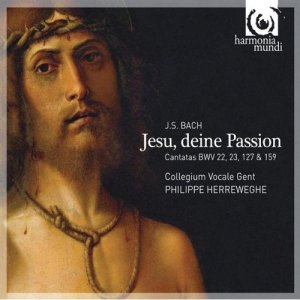 As Cantatas BWV 22 e 23, destinadas ao primeiro domingo antes da Quaresma, funcionaram como “peças de concurso”, quando Bach se candidatou ao lugar de Kantor da Igreja de São Tomé em Leipzig, pelo que é natural que o compositor se tenha esmerado na sua concepção. As BWV 127 e 159 foram escritas para o mesmo serviço litúrgico nos anos seguintes.
A interpretação de Herreweghe e dos seus músicos é primorosa, tanto nos planos técnico e estilístico, como no modo em que combina emoção e espiritualidade. As intervenções do coro revelam uma luminosa transparência, os solistas – a soprano Dorothee Mields, o contralto Matthew White, o tenor Jan Kobow e o baixo Peter Kooy – cantam com enorme convição e um sentido retórico apurado da relação texto-música e os instrumentistas são exemplares, com destaque para os belíssimos solos de oboé (com o grande Marcel Ponseele), que dialogam com as vozes em múltiplas árias. Também as flautas de bisel têm intervenções eloquentes (por exemplo, na ária “Die Seele ruht”, cantada com delicada sensibilidade por Dorothee Mields) ou os trompetes no recitativo “Wenn einstens die Posaunen Schallen”, verdadeira cena dramática evocadora do Juízo Final. A Cantata BWV 159 recorda o universo da “Paixão segundo São Mateus”, destacando-se a poderosa ária de baixo “Es ist vollbracht” e a ária de contralto “Ich folge di nach”, que se desenrola em contraponto com o soprano que entoa a estrofe do conhecido coral “Ich will hier bei dir stehen”.
Sem Rede
One, Two, Three, Four: No Rehearsal, Go
O artigo de Ben Ratliff , publicado em 9 de Dezembro de 2009, está no The New York Times.
Os samples estão na ECM (cortesia do ZMCP) 🙂

Banda Sonora da Trindade Maldita
Trata-se do mais recente livro-disco de Jordi Savall, dedicado a assinalar os 500 anos do nascimento de Francisco de Borja (1510–1572), o último membro da Dinastia Borgia, celebrizada quer pelos motivos mais nobres quer pelos mais tenebrosos do período Renascentista. Está tudo explicadinho nesta página que criei, tendo por base a recolha de informação, principalmente nas páginas da AliaVox e do YouTube.
Requiem de Michael Haydn
| Parte 2 | Parte 3 | Parte 4 | Parte 5 | Parte 6 | Parte 7 | Parte 8 | Parte 9 |
Carolyn Sampson, soprano | Hilary Summers, contralto | James Gilchrist ,tenor | Peter Harvey ,baixo |
Choir of the King’s Consort | The King’s Consort | Robert King
“Robert King suggests that Michael Haydn‘s Requiem of 1771 for the Archbishop-Prince of Salzburg (28-02-1698 / 16-12-1771) reflects a personal outpouring of grief for the loss of Haydn’s beloved patron and the recent death of his infant daughter. The fervent expressions of grief, consolation and hope must have made some impression on the 15-year-old Mozart. A comparison with Mozart’s Requiem setting of 20 years later is inevitable: Haydn didn’t give his solo quartet anything that compares with the immediacy of Mozart’s ‘Tuba mirum‘, but the older man’s masterful choral writing, brilliant orchestral scoring and sensitive use of solo voices created plenty of musical riches and dramatic moods, such as the brooding Kyrie and the bursting energy of the ‘Dies irae’.
The quartet of soloists is impeccable; the choir and orchestra of The King’s Consort prove to be increasingly assured and dynamic with each recording released. Robert King’s measured and emphatic direction makes it easy to appreciate why the Requiem was performed at his brother Joseph’s funeral in 1809.
His interpretation of the sunnier, extrovert Missa in honorem Sanctae Ursulae (1793) helps the music to sound natural and spontaneous. In some respects the Mass is an even finer composition, full of charismatic and inventive musical charms (it’s worth buying for Carolyn Sampson’s ravishing ‘Benedictus’ alone).
Anybody who enjoys the choral works of Mozart and Joseph Haydn will be delighted by this double-disc set, and will probably concur that Michael Haydn’s neglect in the shadow of his younger friend and older brother is substantially corrected by these exquisite performances.” Gramophone Classical Music Guide, 2010. Via.
The Universe in a Nutshell

TAG LIST
- Videos
- Wayne Shorter
- Cubismo
- José Bento
- Jazz
- Antena 2
- Renascimento Italiano
- HIGH-RES
- FCG
- Renascimento
- Miles Davis
- Música Sacra
- Museu do Prado
- Exposições
- Le Petit Prince
- Barroco Francês
- Blue Note Records
- Johann Sebastian Bach
- João Chambers
- Fotografia
- Renascença
- Museu Thyssen
- Jordi Savall
- Barroco Italiano
- Hard Bop
- Impressionistas
- Pablo Picasso
- Barroco Alemão
- Musica Aeterna
- Barroco

Fondation Louis Vuitton
Du 09/04/25 au 31/08/25

Musée Jacquemart-André
À partir du 19 mars 2025

Tate Britain, London
Guest House
- 1.170.365 visitors
Calendário Cósmico
| S | T | Q | Q | S | S | D |
|---|---|---|---|---|---|---|
| 1 | ||||||
| 2 | 3 | 4 | 5 | 6 | 7 | 8 |
| 9 | 10 | 11 | 12 | 13 | 14 | 15 |
| 16 | 17 | 18 | 19 | 20 | 21 | 22 |
| 23 | 24 | 25 | 26 | 27 | 28 | 29 |
| 30 | 31 | |||||
NASA’s James Webb Space Telescope

Mars Perseverance Rover

Painéis de S. Vicente — A casa do restauro

Música em São Roque

FESTIVAL DE MÚSICA ANTIGA DE TORRES VEDRAS

Festival Internacional de Música da Póvoa de Varzim

Cistermúsica 2020

Categorias
Arquivo de Posts
Últimos Posts
- Max Richter no Gira-Discos
- Relações Simbióticas
- ‘Figure in Blue’, de Charles Lloyd
- ‘Notas Azuis’ 2.0
- ‘Flores de musica pera o instrumento de tecla & harpa’
- Mestre Ralph Towner
- 60 anos de ‘Live At The Plugged Nickel’ (II)
- 60 anos de ‘Live At The Plugged Nickel’
- ‘The Opening of the Wallhalla’, de William Turner
- ‘Murnau: Top of the Johannisstrasse’, de Kandinsky
 António Branco Almeida
 Ana Margarida Lopes
Visita Guiada
 Visita Guiada é um programa de televisão e de rádio que dá a conhecer o Património Cultural português.
 O Universo Numa Casca de Noz