Duarte Mendonça começou a produzir o Cascais Jazz em 1974, já na sua quarta edição. Agora é o responsável pelo renascimento do festival que partiu do visionário Luís Villas-Boas.
Há pouco mais de 35 anos, o septeto de Miles Davis tocava no Dramático de Cascais e dava início ao mais mítico Festival de Jazz do País. O advogado Daniel Proença de Carvalho recorda o concerto que mais o marcou “pela total perplexidade que gerou. Não esperávamos aquela música, a liberdade dos músicos jovens que acompanharam Miles Davis. Ficámos hora e meia em silêncio e só depois vivemos uma explosão de emoção”, descreve ao DN. O advogado foi um dos 12 mil ‘privilegiados’ que assistiu ao festival que o próprio músico fez questão de abrir. Após um longo interregno de 21 anos, o Cascais Jazz está de regresso. E com ele uma mão cheia de músicos que marcaram os palcos de Cascais na época.
A ideia de retomar o festival de Cascais, já em Dezembro, partiu de Duarte Mendonça, actualmente ligado à produção de eventos como o Estoril Jazz e que co-produziu o Cascais Jazz a partir de 74: “Estava na Praia Verde [Algarve] quando me questionei sobre o que teria acontecido à marca do Cascais Jazz. Quando cheguei, liguei para o Instituto de patentes e resolvi registar a marca, bem como a insígnia”, refere ao DN.
Duarte Mendonça contactou a família de Luís Villas-Boas, que deu início ao festival, e o presidente da Câmara, António Capucho, que “ficou encantado com a ideia”, frisa. A primeira (re) edição, em memória de Luís Villas-Boas, está agendada para os dias 4,5 e 6 de Dezembro no Centro de Congressos do Estoril. Assumindo que ainda não sabe como vai constituir o elenco deste festival nos próximos anos, Duarte Mendonça apenas assegura que “será semelhante ao do Estoril Jazz. A diferença entre os dois festivais estará no Jazz Latino. Estou a pensar introduzir dois concertos de bandas mais ligadas à bossa nova e salsa no Estoril Jazz já na próxima edição”, refere.
A ideia de organizar mais um festival não assusta o organizador, agora com 78 anos. “O que faz a idade das pessoas é a cabeça”, brinca. “Eu sinto que tenho 40 anos de cabeça”, conclui. Por Diana Gomes – DN
Excelentes notícias!! Vamos lá matar saudades do que não vi… 🙂
Thelonious Monk played his first San Francisco club engagement in October of 1959. According to all accounts, opening night (at theBlack Hawk, one of the city’s two top-ranked jazz clubs) was close to a total disaster. In a complete reversal of the way legend has always typecast Thelonious, he showed up for work more or less on time – but he was the only one on the bandstand. The rest of his quartet never made it.
Well, actuallyCharlie Rouse, who had joined Monk almost exactly a year earlier and was to remain his constant working companion through the entire Columbia Records period, showed up for the second set. (His excuse was weird enough to have the ring of truth to it. Arriving in town that afternoon, and feeling quite travel-weary, he had checked into a YMCA near the club and took a nap that lasted quite a while longer than planned, having requested a wake-up call that for some reason was never made.) This was more than two years after Monk’s great breakthrough, when playing with the emerging John Coltrane at New York’s soon-to-be-legendaryFive Spot had started him towards new heights of public acclaim. Nevertheless, the booking apparently only paid enough to enable him to take one sideman across the country. The Los Angeles bassist and drummer hired for the week showed up the next day, but it was no way for a great pianist to first encounter one of America’s great cultural centers.
I know all of this for a certainty because I was in San Francisco at the time. Actually, the only reason I wasn’t at the Black Hawk that evening was because I was recording not too far away – at the Jazz Workshop, where the youngCannonball Adderley quintet was taping a “live” album that would lead them to world-wide stardom.
(Major companies often having been slow to respond to the less obvious jazz forms of that day, both artists were then recording for my New York based independent label, Riverside.) During the week I had reason to learn that Theloniouswas rapidly gaining an appreciation of the California city; I still vividly recall the day he took me to lunch at a family-style Italian restaurant in the North Beach area, where the staff greeted him affectionately.
Among the more important things that happened to Monkduring the next few years were several returns to the jazz clubs of that city and the beginning of a long relationship with a major label. The latter move led to a much higher profile for Thelonious, including the same rare honor gained by fellow Columbia Records star Dave Brubeck – having his picture on the cover of Time magazine! In the fall of 1964, the two elements combined when Monk, this time carrying a full cadre of musicians, played successive engagements at the It Club in Los Angeles, and the Jazz Workshop in San Francisco, and Columbia elected to record him in performance at both venues. (Opening night in the City by the Bay was, without question, a much happier occasion than in 1959.)
Of course there was a bit of maneuvering and inconvenience involved. Either economy or efficiency, or perhaps the schedule of Teo Macero, Monk’s designated producer at the label, dictated that the two chunks of location recording were jammed together – almost literally back to back. The band was recorded in Los Angeles on a Saturday and Sunday, the last two night of that stand, and then again further north on the first two of the next. (And Monkbarely got time to travel – a good part of his off-day was spent in a Los Angeles studio cutting five numbers for a planned solo piano album.) It actually is a seriously bad idea to record right at the start of an on-the-road club date. The musicians haven’t yet gotten used to their new hotel rooms and how to get from the lobby to the job, let alone feeling comfortable and relaxed on the bandstand or in the backstage area, or accustomed to how they sound in the room.
But in addition to several better-known attributes, Thelonious Monk was a thorough professional, capable of working productively under almost any circumstances. It helped that he possessed limitless self-confidence – including both an instinctive faith in his own ability and the conviction that he had clothed his sidemen in the same invulnerable armor. And more than any other jazz artist in my experience, he seemed able to block out the influence of the tape machine, to proceed without appearing to be altering his performance to accommodate the requirements of recording. If you happen to be the producer in charge of the live recording session, this last quality is not necessarily a good thing. Usually – though perhaps not always – some adjustments should be made. Visual elements help make a drum solo more exciting; maintain audience interest for longer stretches of time, involve the viewer/listener more deeply through the charisma of an intriguing personality. But in constructing an album that will remain fascinating when deprived of any visual aids, it is not always possible to retain total reality. The most effective live recordings are often those that appear to be entirely natural and unrestricted, but actually are planned and disciplined. Monkwas never particularly interested in or approving of simulation or compromise in connection with his music. (I have produced what I consider rather successful in-person Monk albums, but it certainly was far from easy.)
One striking characteristic of the body of music here is the lack of repetition. Aside from the set-closing theme, “Epistrophy,” only one number (“Evidence”) appears to have been played more than once a night. This much variety is certainly how Thelonious would have programmed an evening of club work, but it is definitely not the prescribed way to make a record. In the studio, standard procedure is to repeat a selection until you are satisfied, then go on to the next. Most club recording varies this only by not repeating anything immediately, but concentrates on limited repertoire and repeats almost everything in each new set – which in this era meant three or four times a night. This may partially explain why Columbia issued virtually none of the 1964 California live material for almost two decades – and then only chose to release a limited number of selections. And several of those had been trimmed in length to something closer to the duration of a studio recording, usually by drastic shortening or even elimination of bass and drum solos.
But in preparing the reissue versions of this material, I was fortunately not asked to prepare a ‘normal’ record. Instead, it could be something of more historical validity, could draw its real strength from being a valid recreation of how it felt to spend time in a club when Monk was performing. Basically this is a pretty complete recreation of what he played when the tape machines were rolling on each of his quartet’s first two nights at the Jazz Workshop. Some selections were, for whatever reasons, incompletely recorded, and there’s a good possibility that tape was not continuously rolling all the time. But this is whatever can be considered issuable from two nights of work. It seems clear that the audience for jazz records usually demands perfection in what emerges from the studio, but is quite prepared to relish quirks and imperfections in on-the-spot recordings. That works out particularly well in this instance. If what you are looking for in a ‘live’ recording is something direct and honest, possibly a little rough (as the artist recalls and reaches out for a number he may not have included in his standard repertoire for years), but never at all routine or standardized – if that’s what you have in mind, it’s hard to think of anyone better equipped than Thelonious to provide it. Via.
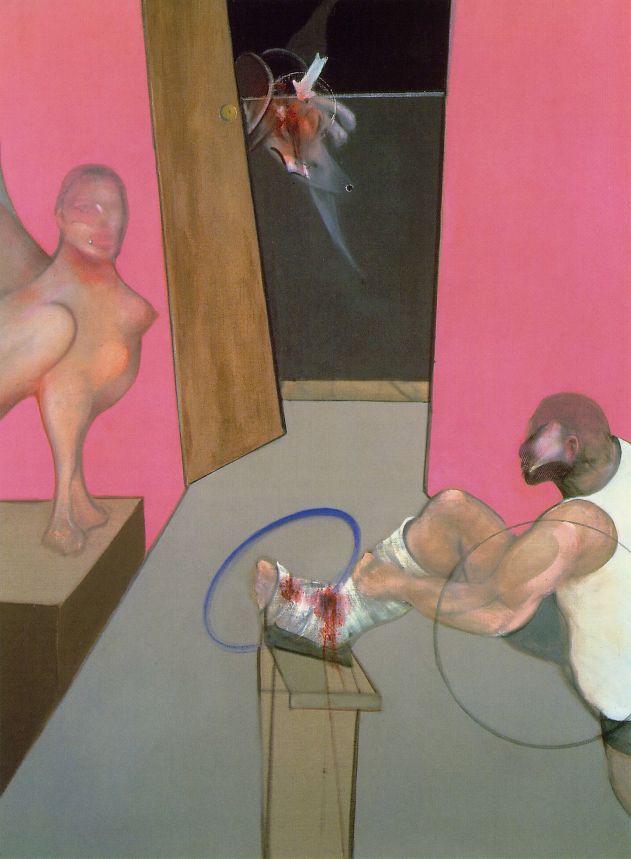
Jean-Auguste Ingres e Francis Bacon lado a lado no Museu Berardo
Em 1983, Francis Bacon (1909-1992) inspirou-se numa composição do famoso pintor francês Jean Auguste-Dominique Ingres (1780-1867) sobre o tema mitológico do diálogo entre Édipo e a Esfinge. O empréstimo excepcional do Musée du Louvre tornará possível a confrontação entre a obra de Ingres, Oedipus and the Sphynx (iniciada em 1808 mas alterada para ser exposta no Salon em 1827) e a obra de Francis Bacon – Oedipus and the Sphinx (after Ingres) – 1983, que pertence à Colecção Berardo.
Jean Auguste-Dominique Ingres – Oedipus and the Sphynx, 1808-25 – Oil on canvas, 189 x 144 cm
Musée du Louvre, Paris
Em Oedipus Tyrannus de Sófocles, Édipofoi ter com a Esfinge que bloqueava a estrada para Tebas e desafiava qualquer viajante a responder a um enigmaou a morrer. Édipo conseguiu resolver o enigma…
Francis Bacon - Oedipus and the Sphinx (after Ingres), 1983
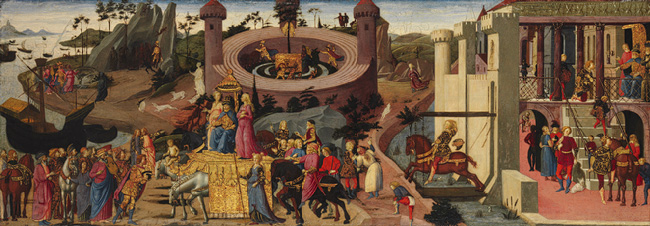
Biagio d’Antonio – Scenes from the Story of the Argonauts, ca. 1465 – Tempera on panel
Master of the Argonauts
These two panels with lively depictions of scenes from the stories of Jason and the Argonauts were designed either as the fronts of cassoni or as spalliere, hung at above shoulder height. As with other complex narrative constructions of the period, such as some of Ghiberti’scompositions for the bronze doors of the Baptistery of Florence, the stories proceed across the picture plane and in depth, and the illusionistic manipulation of space through perspective is central to their effect.
Most of the tale is told according to the epic poem Argonauticawritten in Greek by Apollonius of Rhodesand studied in the Medici circle. Vernacular versions supplied some of the details, and in this sense the panels resemble those painted in celebration of the Tornabuoni-Albizzi marriage some years later, to which Biagio d’Antonio also contributed.
Biagio d'Antonio - Scenes from the Story of the Argonauts, ca. 1465
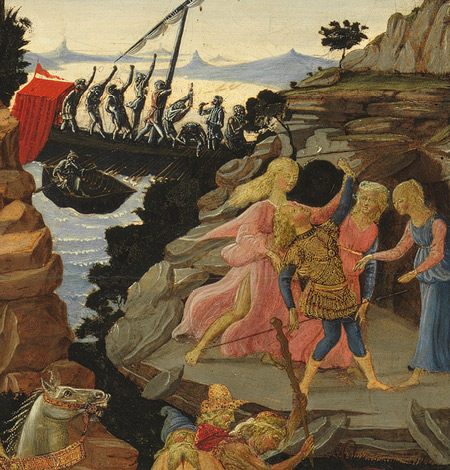
Panel 1: Charge of King Pelias to Jason, his nephew, to retrieve the Golden Fleece from a cave in Colchis on the Black Sea (in each scene, Jason is in golden armor, pink cloak, and winged helmet). Jason seeks adventurers to follow him. Jason and Orpheus, with his viol, consult the centaur Chiron atop Mount Pelion. Jason’s ship, the Argo, sails along the Mysian coast. Hylas, Hercules’ squire, is pulled into a pool by nymphs and never seen again. The Calydonian boar hunt at the far right is not in Apollonius’ account.
The Tale of the Argonauts (left to right):
Biagio d'Antonio - Scenes from the Story of the Argonauts, ca. 1465 (left)
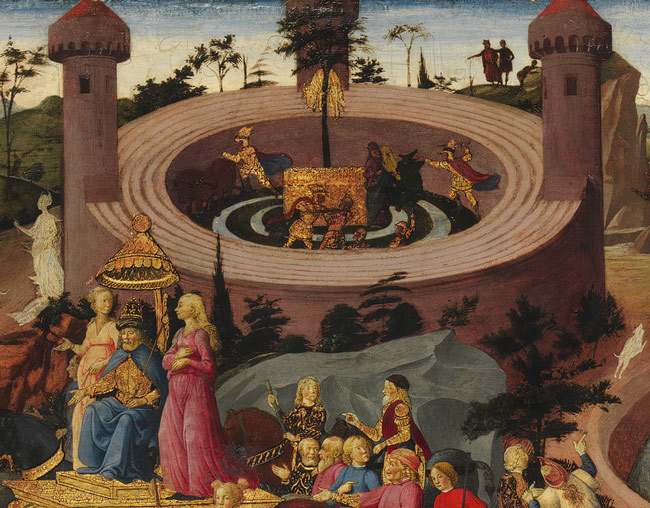
Biagio d'Antonio - Scenes from the Story of the Argonauts, ca. 1465 (center)
Biagio d'Antonio - Scenes from the Story of the Argonauts, ca. 1465 (right))
Scenes from the Story of the Argonauts, cassone panel, ca. 1465
Panel 2: Jason arrives at Colchis greeted by King Aeëtes with his daughters Medea and Chalciope. Jason begins to carry out his appointed tasks under the protection of the sorceress Medea. He is able to grab the Golden Fleece from the labyrinth and flees with Medea. Aeëtessends Medea’s brother in pursuit; he may be the young man riding in haste across the castle’s moat.
In this panel and its companion, the story of Jason and the Argonauts unfolds in a continuous narrative.
Scenes from the Story of the Argonauts, cassone panel, ca. 1465 (left)
Here, at the left, Jason is charged by King Pelias to retrieve the Golden Fleece. Jason is then shown mounting his horse, and consulting the centaur Chiron on Mount Pelion, along with Hercules and Orpheus.
Scenes from the Story of the Argonauts, cassone panel, ca. 1465 (center)
In the distance is Jason’s ship, the Argo. This unidentified master was an assistant in Biagio di Antonio’s workshop.
Scenes from the Story of the Argonauts, cassone panel, ca. 1465 (right)
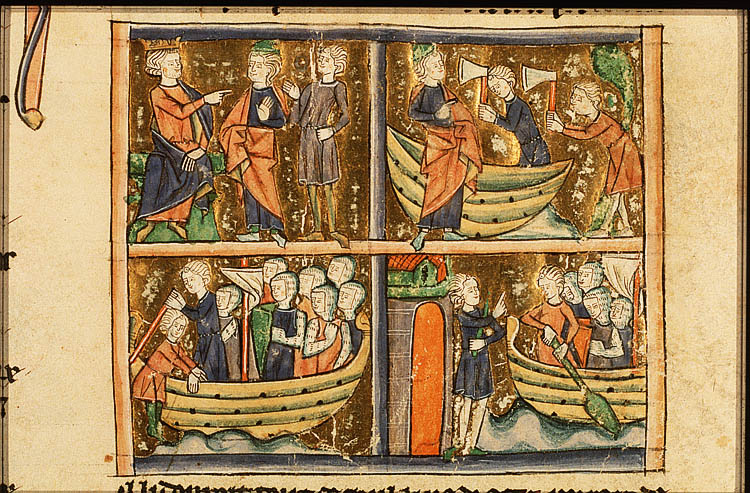
Na primeira imagem, Peleu, pai de Aquiles, ordena a construção de Argo, destinada à demanda da lã de ouro do carneiro alado, ao sul das montanhas do Cáucaso. Na segunda imagem, vemos a construção da embarcação, com a ajuda da deusa Atena. Nas imagens seguintes, vemos o início da expedição de Argo.
Hoje, a música dos argonautas leva-nos para o Hemisfério Norte Celestial, a Andrómeda – não a filha de Cassiopeia -, mas à região das nebulosas, que é longe que se farta. 🙂
A viagem tem uma duração aproximada duas horas terrenas e o mano tem honras de abertura, com o tema Space Orgone.
Na Antena 2, a partir das 22h00 – Jorge Carnaxide.
Alinhamento dos Planetas: Planetário III
Jos D´Almeida – “Space Orgone” – Software – “Julia´s Dream” – Tiamat – “Planets” – Kevin Keller – “Orbit” – Lightwave – “Tycho On the Moon” – Tomita – “The Orb of Beauty” – Cliff Martinez – “Wormhole” – Software – “Dea Alba” – Megt Bowles – “Slow Weave” – Patrick O´Hearn – “Beneath the Celestial Sphere” – Brian Eno – “Always Returning II” – Tó Neto – “Zuzu”
A 17 de Novembro chega “The Catalogue”, caixa de oito discos que reúne todos os álbuns editados entre 1974 e 2003. Em 2010 o novo álbum
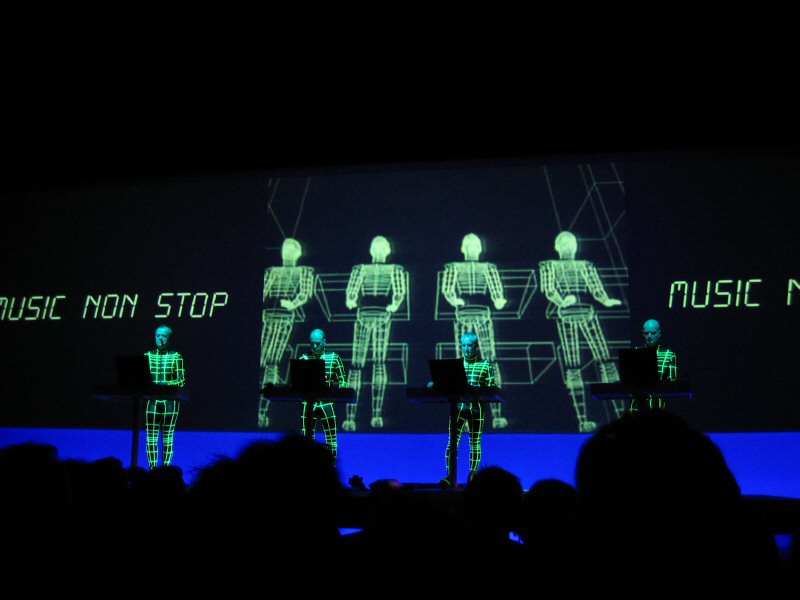
Kraftwerk – Minimum-Maximum, 2004
Como todos sabemos, os Kraftwerk, pioneiros da pop electrónica, nome destacado do “kraut-rock“, são banda de gente cerebral e arrumadinha. Todas as suas acções são arquitectadas com a precisão geométrica de uma auto-estrada germânica e com a sagacidade do Lance Armstrong dos bons velhos tempos – e eis-nos assim a referir de forma enviesada “Autobahn” e “Tour de France“, dois dos temas mais emblemáticos da banda alemã. Tudo isto para falar dos seus próximos passos. Primeiro, a 17 de Novembro, chega “The Catalogue”, caixa de oito discos que reúne todos os álbuns editados entre 1974 e 2003, celebrando o 35º aniversário da supracitada “Autobahn”. Depois da reavaliação histórica, o futuro. Ralf Hutter, um dos fundadores, anunciou à Billboard que os Kraftwerk começaram a trabalhar num novo álbum de originais, a editar em 2010. Será o primeiro após a saída de Florian Schneider, outro dos fundadores, e, para já, Hutter não tem muito a adiantar: “Ainda está numa fase embrionária.” Com os Kraftwerk não há espaço para especulações. Tudo muito certinho e arrumadinho. Como é que era mesmo? Isso: “Man machine.”. Via.
Outra vez te revejo – Lisboa e Tejo e tudo -,
Transeunte inútil de ti e de mim,
Estrangeiro aqui como em toda a parte,
Casual na vida como na alma,
Fantasma a errar em salas de recordações,
Ao ruído dos ratos e das tábuas que rangem
No castelo maldito de ter que viver…
Outra vez te revejo,
Sombra que passa através das sombras, e brilha
Um momento a uma luz fúnebre desconhecida,
E entra na noite como um rastro de barco se perde
Na água que deixa de se ouvir…
A expansão da fé cristã, num espírito que prolonga o das Cruzadas, levou à conquista de Ceuta, 1415. Iniciou-se a partir desta data a marcação de pontos estratégicos de controlo dos acessos ao mar Mediterrâneo, centro do comércio europeu então dominado pela presença árabe.
A par da navegação no oceano Atlântico, das viagens pela costa ocidental africana até ao Cabo Bojador, 1434, limite sul das terras então conhecidas, do estabelecimento de uma feitoria em S. Jorge da Mina, 1482, passou-se o Cabo das Tormentas, depois designado da Boa Esperança, 1487, assim se marcando a entrada no oceano Índico.
Conheceram-se os escultores/artesãos da Serra Leoa que talhavam marfim com grande requinte e talento, qualidades reconhecidas pelos navegadores portugueses que lhes encomendaram objectos para uso na Europa como saleiros, colheres, trompas, produtos exóticos no material e na expressão artística que, com frequência, copiavam gravuras que circulavam nos livros de culto cristão. Mais a sul, no Benim, ter-se-ão feito, após a invasão da Serra Leoa em 1550, encomendas semelhantes.
Chegados à foz do rio Congo em 1485, aí se funda a primeira igreja, 1491, havendo uma produção de esculturas em metal com expressão africana mas representando imagens de culto cristão, apropriação singular do imaginário e da mentalidade europeia. Via.
Mosqueteiro - Reino do Benim, povo Edo - século XVI
O Reino do Benim entrou pela primeira vez em contacto com os europeus entre 1472 e 1486 e os seus governantes depressa se aperceberam da utilidade da sua chegada para a consecução dos seus interesses políticos. O equipamento militar dos portugueses, em particular, mereceu o maior interesse, uma vez que as armas de fogo eram desconhecidas. De facto, com o auxílio dos seus mosquetes e canhões, foram conseguidos importantes triunfos. Os soldados armados em breve se tornaram tema da arte do Benim. Em circunstâncias religiosas e rituais específicas, essas imagens criavam uma ligação simbólica a Olokun, deus do mar, e é possível que este tipo de figura exibindo as suas armas, funcionasse como defesa extremamente eficaz contra adversários, tanto visíveis como invisíveis. Estilisticamente, esta representação é única, pois contém um elemento de dinamismo e movimento que revela e torna claro o perigo e o poder aparentemente sobrenatural das armas de fogo.
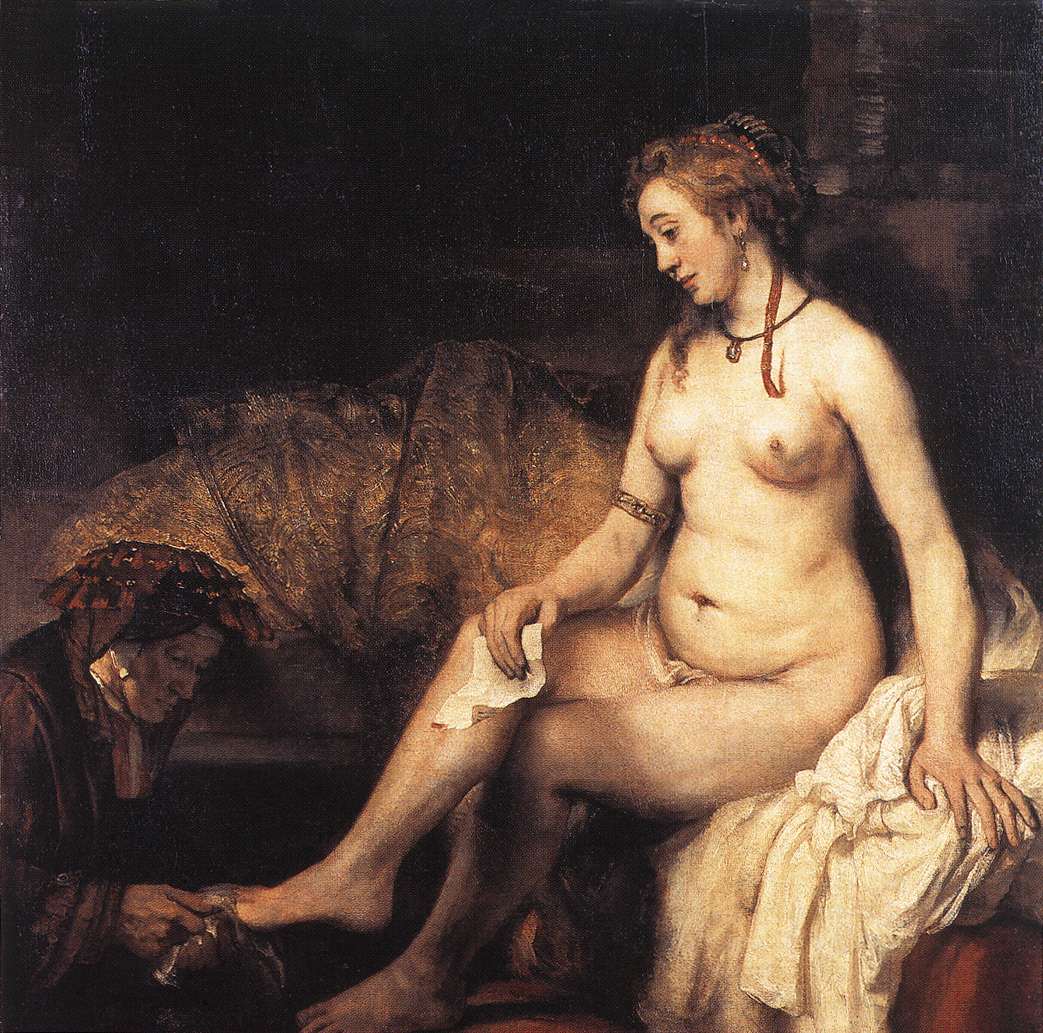
O último e mais belo nu de Rembrandt (1606-1669) como despudorado pretexto 🙂 para divulgar a página sobre o pintor holandês, elaborada a partir do texto gentilmente cedido por João Chambers, que co-produziu o programa Herança de Atena de 18 de Janeiro de 2009 com Ana Mântua, destinado a assinalar a passagem dos 340 anos da morte do Mestre!
Rembrandt Harmenszoon van Rijn - Bathsheba at Her Bath, 1654
David Hockney 25 Fondation Louis Vuitton Du 09/04/25 au 31/08/25
Artemisia - Héroïne de l'art Musée Jacquemart-André À partir du 19 mars 2025
Join the celebrations for JMW Turner’s 250th anniversary in 2025 Tate Britain, London
Guest House
1.171.158 visitors
Calendário Cósmico
Abril 2026
S
T
Q
Q
S
S
D
1
2
3
4
5
6
7
8
9
10
11
12
13
14
15
16
17
18
19
20
21
22
23
24
25
26
27
28
29
30
Jos d’Almeida
Jos d'Almeida é um compositor de música electrónica épico sinfónica, podendo este género ser também designado como Electrónico Progressivo. Na construção de um som celestial, resultante da fusão de várias correntes musicais, JOS utiliza os sintetizadores desde o início dos anos 80.
Chuck van Zyl
Chuck van Zyl has been at his own unique style of electronic music since 1983. His musical sensibilities evoke a sense of discovery, with each endeavor marking a new frontier of sound.












 António Branco Almeida
 Ana Margarida Lopes



 Visita Guiada
 O Universo Numa Casca de Noz