From Mary Stevenson Cassat [22 May 1844 – 14 June 1926], ‘Woman with a Fan’, c. 1878/1879.
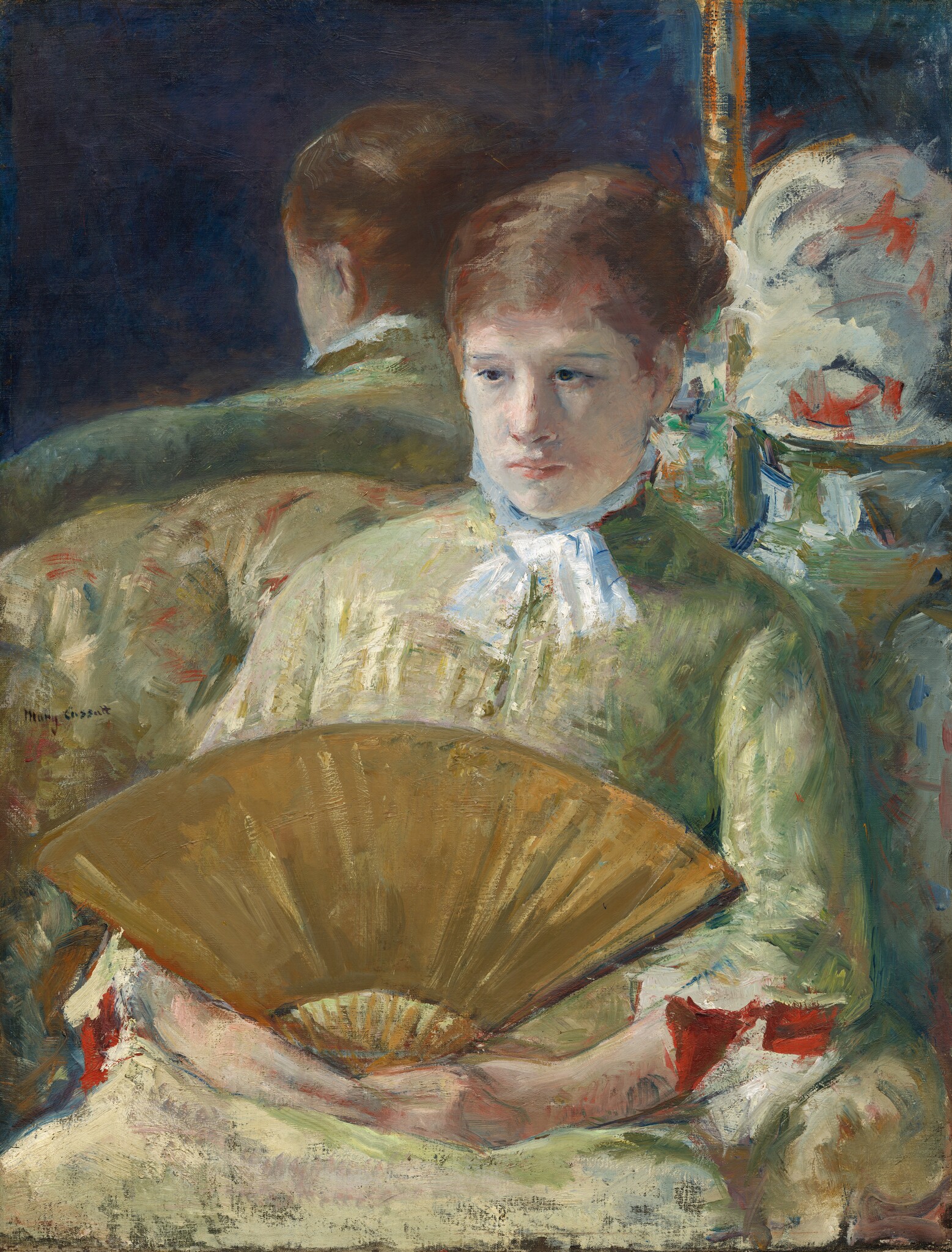
Miss Mary Ellison, c. 1880, oil on canvas
Chester Dale Collection – National Gallery of Art, Washington
This painting is the second of two portraits by Mary Cassatt thought to be of Mary Ellison. Cassatt painted the first in 1877, shortly after she met Miss Ellison through their mutual friend, Louise Waldron Elder (later Mrs. H. O. Havemeyer, a well-known American art collector and a patron of Cassatt). Cassatt does not flatter but, rather, concentrates on Miss Ellison’s contemplative mood.
In this painting, Cassatt demonstrates her affinities with the impressionists. Her brushwork is open and sketchy, and she favors a strong compositional structure over pictorial detail. The mirror behind Ellison was a device the artist used often; its presence allowed the expansion of the composition’s implied space to include areas that the viewer could not otherwise see. Via.
Na passagem de mais um aniversário de nascimento do organista, cravista e compositor Carlos Seixas [1704-1742], cuja curta vida de 38 anos decorreu durante o reinado de D.João V [1689-1750], José Carlos Araújo no cravo interpreta o Allegro, primeiro movimento da Sonata IX em dó maior.
Como referências da importância que o monarca atribuía à arte dos sons, a contratação em 1719 de Domenico Scarlatti, de quem Carlos Seixas foi discípulo, e o contemporâneo Francisco António de Almeida [1703-1754], que em 1722 recebeu do Rei uma Bolsa para estudar em Itália.
De Thomas Tomkins [1572 – 9 Junho 1656], natural do País de Gales e notável membro da lista de compositores que integrou a English Madrigal School, o madrigal nº 17 See, see, the shepheards Queen, pertencente à colectânea de 28 madrigais – Songs of 3, 4, 5 and 6 parts, publicada em 1622.
Intérpretes – Hilliard Ensemble · Paul Hillier
Paul Gauguin [7 June 1848 — 8 May 1903] executed this harvest scene whilst staying at Le Pouldu in Cap Finistère, Brittany. He had been the central figure of a group of painters at the nearby village of Pont-Aven. Then in 1890 he moved to Le Pouldu in search of an even simpler way of life. By this time Gauguin had abandoned his early Impressionist manner. Influenced by folk art and primitive art, he began to use flat areas of colour and a distorted perspective in his paintings. The landscape and life of the peasant community inspired some of the most rugged and radically simplified works of his career. Via tate.org.uk.
Gravado em 2 Junho 1964 para a Blue Note nos estúdios da CBS em Paris, One Flight Up contou com a participação de: Donald Byrd [1932-2013], trompete e autor do tema Tanya * Dexter Gordon [1923-1990], saxofone tenor * Kenny Drew [1928-1993], piano * Niels-Henning Orsted Pedersen [1946-2005], contrabaixo * Art Taylor [1929-1995], bateria.
Having a few earlier Dexter albums where he solos more or less continuously, it’s great to find him give lots of space to the other players, particularly in the Byrd-penned “Tanya” which occupies all of side one, almost eighteen minutes. A minor modal vamp, shifting backwards and forwards, resolving in a boppish rhythmic romp, only to restart. Dexter is quietly restrained, Byrd plays to Hubbard, Drew plays to Pearson and Hancock, Taylor mixes Blakey with a touch of Williams, and NHOP walks dreamlike through the 18 minute space. Choose your own analogies and adjectives, hypnotic, intoxicating stuff. – The LondonJazzCollector.
Quem escolheu esta minha maneira de viver?
Texto | © Vítor Vieira
Foto | fotografarpalavrasAnaMargaridaLopes © Ana Margarida Lopes
Projecto | fotografar palavras © Paulo Kellerman